
Buying insurance for an electric car in India feels like it should be a different world — new technology, a giant battery, charging cables, software. In practice, an EV is insured under exactly the same motor framework as a petrol or diesel car: third-party cover, standalone own-damage, or comprehensive, with the usual add-ons. What changes is not the paperwork but the economics of a claim — and three of those changes can quietly cost you lakhs if you insure or claim without understanding them.
An EV uses the same policy structure as any car
There is no separate “EV insurance” category in India. Your electric car is covered by the same three building blocks as any other vehicle. Third-party liability is mandatory under the Motor Vehicles Act and pays for injury or damage you cause to others. Own-damage (OD) cover pays for damage to your own car. Comprehensive is simply OD and third-party sold together, and it is the only combination under which your battery, motor and the car itself are protected against accident, fire, theft and natural calamity.
The same add-ons you would consider on a petrol car apply — zero-depreciation, return-to-invoice, roadside assistance, engine (here, motor and battery) protection, and consumables. On an EV, two of these carry more weight than usual, and we come to why below.
The three things that are genuinely different
Strip away the marketing and an EV claim differs from a petrol-car claim in exactly three places. Everything else — surveyor visit, estimate, approval, cashless or reimbursement — works the way it always has.
1. A cheaper third-party premium
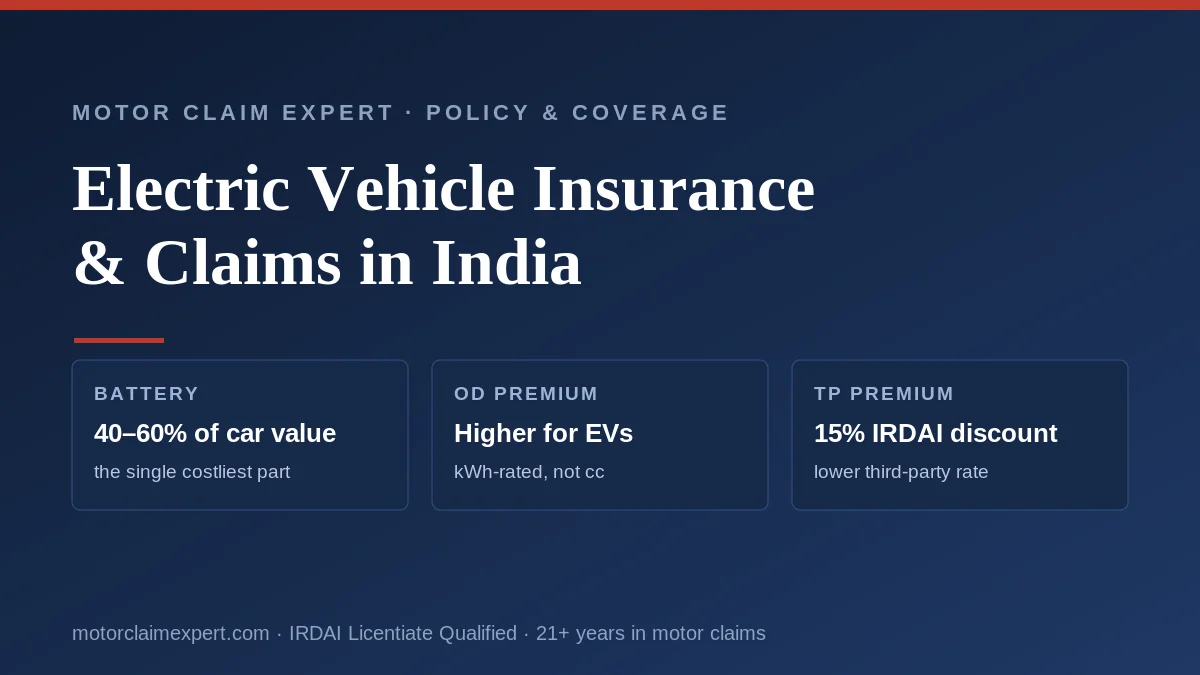
IRDAI has set a 15% discount on the basic third-party premium for private electric cars, reflecting their lower rated output. This is the one place an EV is cheaper to insure — but the third-party premium is the smaller part of a comprehensive policy, so the saving is modest in rupee terms.
2. A higher own-damage premium
The OD premium is the larger part of your policy, and for an EV it is typically higher than for a petrol equivalent. The reason is the sum insured (IDV): the battery and drivetrain make an EV more expensive to repair or replace, so the insurer prices more risk. OD premiums are increasingly rated on battery capacity in kWh rather than on engine cc.
3. The battery is treated as its own high-value part
This is the one that decides EV claims — so it gets its own section.
The battery is the whole game
On a petrol car, no single component is worth more than a fraction of the vehicle. On an EV, the traction battery is commonly 40–60% of the car’s entire value. That single fact reshapes every serious claim: a battery that would need replacing can, on its own, push the repair cost past the 75% of IDV threshold at which insurers declare a constructive total loss and write the car off rather than repair it.
The exclusion most owners miss: accidental impact and fire damage to the battery are generally covered under comprehensive OD — but water and flood damage to the battery is often excluded unless you have bought the relevant add-on. In a country with an annual monsoon, that is not a small gap. Read your policy’s battery wording before you park in a basement or ford a flooded street.
Insider note on depreciation: even when a battery replacement is approved, a standard policy applies depreciation to it — a replacement battery is not paid at full new price unless you hold a zero-depreciation or battery-protect add-on. For a part worth half the car, that depreciation is the difference between a fair settlement and a painful one. On an EV, a zero-dep add-on is not a luxury; it is the point.
Charging and fire risk: what actually matters for a claim
Charging-related fires are rare but visible, and they raise a practical question: is a fire that starts while charging at home a covered claim? Under comprehensive cover, fire damage to the vehicle is generally covered — but insurers will investigate the cause. A fire traced to an unapproved after-market charger, tampered wiring, or a modification you did not declare is where disputes begin.
Protect the claim before it happens: charge on the manufacturer-supplied or approved charger, keep the installation invoice, don’t modify the electrical setup without telling your insurer, and photograph your charging point. If a fire ever occurs, that evidence is what turns a contested claim into a paid one.
How an EV claim differs in practice — side by side
The mechanics of filing are identical to any car — intimate the claim promptly, let the surveyor assess, get the estimate approved, choose cashless or reimbursement. What differs is where the money is. This is the same claim, seen through an EV lens:
| In a claim | Petrol / diesel car | Electric car |
|---|---|---|
| Costliest single part | Engine — a fraction of car value | Battery — 40–60% of car value |
| Total-loss risk | Reached only in severe damage | One battery hit can cross 75% of IDV |
| Flood/water damage | Hydrostatic-lock risk to engine | Battery water damage often excluded without add-on |
| Depreciation that hurts | On plastic/rubber parts | On the battery — the biggest part of all |
| Add-on that matters most | Zero-dep, engine protect | Zero-dep + battery/water protection |
There is one more EV-specific item a surveyor now checks: ADAS calibration. Many EVs carry driver-assistance sensors in the bumpers and windscreen, and after a repair those systems must be recalibrated — a legitimate, chargeable line item that owners of older cars have never seen.
What to check before you insure an EV
Insure an EV as if the battery is the car — because, financially, it very nearly is. The spoke guides below go deeper on each piece: how the battery is covered, why the premium is structured the way it is, the charging-fire question, service-history requirements, and ADAS calibration in claims.
Frequently Asked Questions — EV Insurance & Claims
Is there a separate insurance category for electric cars in India?
No. EVs are insured under the same motor framework as any car — third-party, standalone own-damage, or comprehensive, with the usual add-ons. The main differences are the battery’s treatment, a third-party premium discount, and higher own-damage premiums.
Do electric cars get an insurance discount?
Yes, on the third-party portion. IRDAI has set a 15% discount on the basic third-party premium for private electric cars. The own-damage premium, which is the larger part, is typically higher than for a petrol equivalent.
Is the EV battery covered by insurance?
Accidental and fire damage to the battery is generally covered under comprehensive own-damage cover, but water/flood damage to the battery is often excluded without an add-on, and a replacement battery attracts depreciation. See our dedicated battery-cover guide.
Why is EV own-damage insurance more expensive?
Because the car — and above all the battery, which can be 40–60% of its value — costs more to repair or replace. That raises the own-damage premium even though the third-party premium carries a discount.
Does an EV claim need ADAS re-calibration?
Often, yes. Many EVs carry driver-assistance sensors, so a front-end or windscreen repair usually requires ADAS re-calibration — a legitimate, chargeable part of the claim you should ensure is included.
Is a charging or battery fire covered?
Fire is a covered peril under comprehensive own-damage cover, including a charging-related fire, but EV fire claims are investigated closely and insurers may raise a manufacturing-defect question. See our EV charging and fire guide.
Does zero depreciation matter more on an EV?
Generally yes, because so much of an EV’s value sits in parts that would otherwise be depreciated at claim time. On a new EV, a zero-depreciation add-on often pays back faster than on a comparable petrol car.
Sources & official references
- IRDAI: the 15% discount on the basic third-party premium for private electric cars is set by IRDAI’s motor third-party premium framework.
- Policy wording: what own-damage cover pays for the vehicle and battery, and the depreciation applied to a replaced battery, is set by your insurer’s IRDAI-approved motor policy wording; batteries are depreciated under the standard parts schedule.
- Product note: battery-protection and similar EV add-ons are optional IRDAI-filed products; their terms vary by insurer.


