
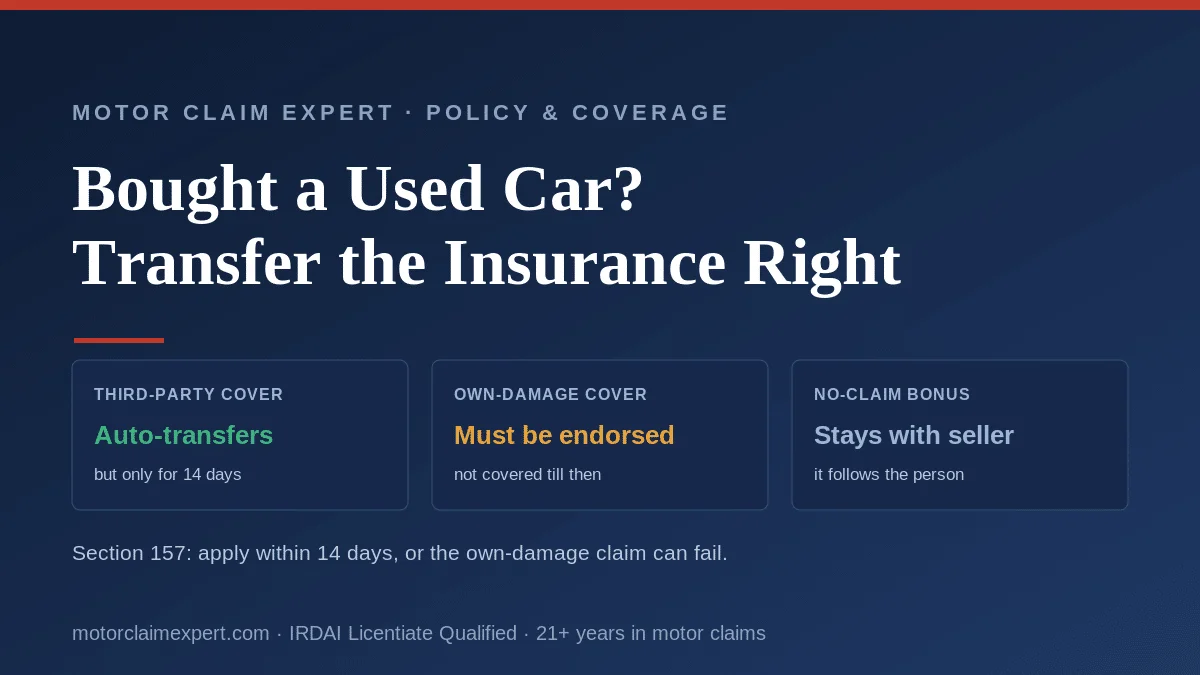
When money changes hands over a used car, everyone remembers the RC transfer and forgets the insurance — until a claim is refused. Second-hand car insurance is riddled with two dangerous myths: that the policy simply carries over to the new owner, and that the No-Claim Bonus travels with the car. Both are wrong, and both cost people dearly. In reality only part of the cover moves automatically, there’s a hard 14-day deadline written into law, and the NCB belongs to a person, not a vehicle. Whether you’re buying or selling, this guide explains exactly what to transfer, when, and who walks away with the bonus.
The 14-day rule — what the law actually says
When a vehicle is sold, Section 157 of the Motor Vehicles Act, 1988 deems the certificate of insurance — that is, the compulsory third-party cover — to be transferred to the buyer from the date of sale. But this deemed transfer is time-limited: the buyer must apply to the insurer to formally transfer the policy into their name within 14 days. The purpose is narrow and important — it ensures a newly bought car is never illegally uninsured for third-party liability on day one. It does not mean the whole policy has quietly become the buyer’s.
Expert note — the own-damage gap nobody warns you about: the automatic transfer covers only the third-party portion. The own-damage section (the part that pays to repair the car you just bought) stays in the seller’s name until you formally apply and the insurer endorses the transfer to you. If you have an accident during those first days — before the endorsement — the insurer can decline the own-damage claim on the ground that you were not the insured for that section at the time of loss. This is the single most expensive mistake in a used-car purchase: driving a car you own, insured in a name that isn’t yours, assuming you’re covered. Apply for the transfer immediately, not “sometime this fortnight.”
The NCB belongs to the person, not the car
Here is the fact that surprises both sides of every deal. A No-Claim Bonus — the discount that climbs to 50% after five claim-free years — is earned by the policyholder, not attached to the vehicle. So when a car is sold, the accumulated NCB does not pass to the buyer with the car. It remains the seller’s to keep and carry to their next vehicle.
| Who | What happens to the NCB |
|---|---|
| Seller | Requests an NCB retention certificate from the insurer, and carries the discount to their next car. Valid up to three years from the policy expiry |
| Buyer | Does not inherit the seller’s NCB. The own-damage premium is recalculated at 0% NCB — unless the buyer has their own retained NCB to apply |
This matters at the negotiating table. Because the buyer’s premium is repriced without the seller’s bonus, the transferred policy is often worth less to the buyer than it looks — and the seller who forgets to retain the NCB before transferring can lose years of hard-won discount. Both sides should settle the NCB question before the policy is transferred.
What goes wrong when the transfer is skipped. Leave the insurance in the seller’s name and the damage runs both ways. The buyer can find own-damage claims refused, and — after the 14-day window — may be personally exposed for third-party liability with no valid cover in their name. The seller stays linked to a car they no longer control: if the new owner has a serious third-party accident while the policy still shows the seller’s name, the seller can be dragged into the investigation and liability. Transferring promptly protects both parties, which is exactly why the law sets a deadline.
What each side must do
Should you transfer the old policy or buy fresh?
A practical call for the buyer: you have two options — transfer the seller’s existing policy into your name, or let it lapse and buy a fresh own-damage policy while relying on the 14-day third-party bridge. Transferring is simplest when the policy has meaningful cover left and a fair IDV. Buying fresh can make sense if the old policy is nearly expired, the IDV no longer reflects the car, or you want to pick your own add-ons like zero-depreciation. Either way, never let the car sit with no own-damage cover in your name — decide before you drive it home. For an older second-hand car specifically, our guide to insuring older cars covers what changes.
A worked example
A used car changes hands cleanly only when the insurance changes hands too. Remember the three truths: just the third-party cover bridges automatically, and only for 14 days; the own-damage cover protects you only once it’s endorsed into your name; and the NCB stays with the seller unless you bring your own. Sellers, retain your bonus before you transfer. Buyers, apply on day one and get the endorsement in writing. For the coverage basics underneath all this, see third-party vs own-damage vs comprehensive, and for how a claim is handled once you’re properly insured, the motor insurance claim process.
Frequently Asked Questions — Used-Car Insurance Transfer
Does car insurance transfer automatically when I buy a used car?
Only the third-party portion transfers automatically, and only for 14 days under Section 157 of the Motor Vehicles Act. The own-damage portion does not transfer until you apply and the insurer endorses the policy into your name.
What is the 14-day rule for used car insurance?
When a vehicle is sold, the compulsory third-party cover is deemed transferred to the buyer, but the buyer must apply to the insurer to formally transfer the policy within 14 days of purchase. Miss it and you risk being uninsured for third-party liability in your own name.
Does the No-Claim Bonus transfer with the car?
No. The NCB belongs to the policyholder, not the vehicle. The seller keeps it by obtaining an NCB retention certificate before transfer, and the buyer’s own-damage premium is recalculated without it unless the buyer has their own retained NCB.
What happens if I don’t transfer the insurance after buying a used car?
Own-damage claims can be refused because the cover is not in your name, and after 14 days you may be personally liable for third-party damage with no valid cover. The seller also stays exposed to liability while the policy shows their name.
What documents are needed to transfer used car insurance?
Typically the transferred Registration Certificate, the existing policy, the sale documents (Forms 29 and 30), the delivery note, and the buyer’s ID and address proof, plus a transfer fee. The insurer may inspect the car before endorsing own-damage cover.
Should I transfer the old policy or buy a new one?
Transfer the existing policy if it has meaningful cover and a fair IDV; buy fresh if it is near expiry, the IDV no longer fits the car, or you want your own add-ons. Never leave the car with no own-damage cover in your name.
Can the seller keep the NCB after selling the car?
Yes. The seller should request an NCB retention certificate from the insurer before the policy is transferred. It is generally valid for up to three years from the policy expiry and can be applied to the seller’s next car.
Sources & references
- Motor Vehicles Act, 1988 — Section 157 (transfer of certificate of insurance and the 14-day application window).
- IRDAI-governed motor policy rules — own-damage transfer by endorsement; NCB belongs to the policyholder and NCB retention certificate (validity up to three years from policy expiry).
- Insurer motor policy wordings and transfer procedures — documents, transfer fee and inspection.


