
Electric-vehicle fires are rare, but charging is where most of the risk — and nearly all of the insurance confusion — sits. The reassuring part is that a comprehensive policy already covers more than most owners assume. The catch is that several EV-specific charging and battery risks fall into gaps that only add-ons close, and one flood-related mistake can turn a covered claim into a rejected one.
This guide separates what your base policy already pays for from the EV gaps you have to plug yourself, explains the exclusion that catches people, and sets out the charging habits that protect both the car and the claim.
What a comprehensive policy already covers
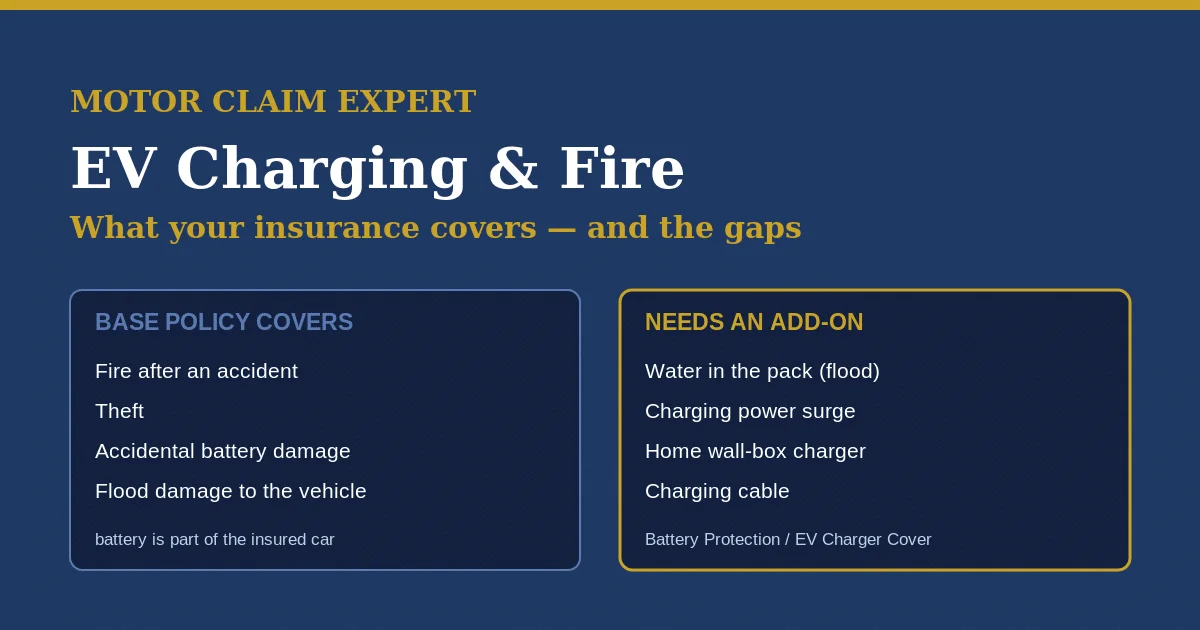
Fire is a standard insured peril. A comprehensive own-damage policy covers your vehicle — including the traction battery, which is part of the insured car — against fire, theft, flood and accidental external damage. So an EV fire caused by an accident or another insured peril is, in principle, covered just as it would be on a petrol car. The battery is covered for sudden, accidental, external events out of the box.
The EV-specific gaps the base policy misses
The trouble is that the standard fire and own-damage clauses were written for combustion cars, not lithium packs. Several distinctly-electric events sit outside them and typically need a Battery Protection add-on (also sold as Battery & BMS Cover or EV Protect):
| Risk | Base policy | Usually needs an add-on |
|---|---|---|
| Fire after an accident or covered peril | Covered | — |
| Water entering the pack while driving through a flooded street | Often not (consequential) | Battery Protection |
| Power surge during charging | Often not | Battery Protection |
| Home charger / wall-box damage | Not — it is an accessory, not the car | EV Charger Cover |
| Charging cable loss or damage | Often not | Add-on |
Battery Protection typically covers repair or replacement of the battery and battery-management system for water or moisture ingress, a charging power surge, short circuit or fire, and costs roughly ₹1,500–4,000 a year.
The exclusion that catches people: the non-OEM charger
Using a non-OEM or uncertified charger can do two expensive things at once: void the battery warranty and trip a named insurance exclusion. Improper charging — an uncertified fast charger, or repeated overcharging — also raises the fire risk itself. As covered in our EV insurance guide, the safest rule is simple: charge only with the approved equipment the manufacturer specifies.
The flood trap — the point that matters most
This is the single most important safety-and-claims warning for an EV owner. Water ingress can cause internal short-circuiting that triggers delayed thermal runaway — a flooded pack can catch fire hours or even days later, often when the owner tries to restart the car. And restarting a flood-soaked EV can convert a payable flood claim into a rejected consequential-loss one, exactly as with a hydrostatic-locked petrol engine.
The home-charging boundary
The wall-box charger installed at your home is treated as an external accessory or a fixed installation — not part of the insured car. A standard motor policy will not pay to replace a home charger that a power surge fries; that needs a dedicated EV Charger Cover add-on, or coverage under your home insurance. And if a fire that starts during home charging spreads to your property, the boundary between motor and home insurance becomes contested — so it is worth declaring the installation and confirming which policy responds.
Is the Battery Protection add-on worth it?
For most EV owners, yes. The battery is 40–60% of the car’s value, so the events this add-on covers — water ingress, charging surges, short circuits — are exactly the low-probability, high-cost risks insurance exists for. At ₹1,500–4,000 a year against a battery replacement that can run into lakhs, it is usually sound value, and it pairs naturally with the other add-ons worth buying. Because the battery is such a large share of the IDV, protecting it protects the bulk of your cover.
A charging-safety checklist
- Use only the manufacturer-approved charger and cable.
- Have home charging run off a dedicated, properly-rated circuit installed by a qualified electrician.
- Avoid habitually charging to 100% and leaving the car plugged in long-term.
- Never charge or restart an EV that has been in flood water — inspect first.
- If the car has been in a fire-risk incident, park it away from structures and other vehicles until checked.
Myth versus reality
| What people assume | What is true |
|---|---|
| “An EV fire isn’t covered by normal insurance.” | Fire is an insured peril; a comprehensive policy covers vehicle fire, including the battery, from accidents and covered causes. |
| “My motor policy covers my home charger.” | The wall-box is an accessory, not the car — it needs an EV Charger Cover add-on or home insurance. |
| “Any charger is fine.” | A non-OEM or uncertified charger can void the warranty and trip an insurance exclusion. |
| “After a flood I can just restart it.” | Restarting risks delayed thermal runaway and can turn a covered flood claim into a rejected consequential one. |
The bottom line
Your comprehensive policy already covers an EV fire from an accident or an insured peril — but the distinctly-electric risks (flood water in the pack, charging surges, the home wall-box, the cable) live in gaps that a Battery Protection and EV Charger Cover add-on close. Add those if the battery matters to you, charge only with approved equipment, and above all never restart an EV that has been in flood water. Get those right and both the car and the claim stay safe.
Frequently asked questions
Does normal car insurance cover an EV fire?
Yes. Fire is a standard insured peril, so a comprehensive own-damage policy covers your vehicle — including the traction battery, which is part of the insured car — against fire caused by an accident or another covered peril, just as on a petrol car.
What EV charging risks are NOT covered by a standard policy?
Distinctly-electric events often fall outside the base policy: water entering the battery pack while driving through a flooded street, a power surge during charging, home wall-box damage, and charging-cable loss. These usually need a Battery Protection add-on (or an EV Charger Cover for the wall-box).
Is my home EV charger covered by my car insurance?
No. The wall-box charger at home is treated as an external accessory or fixed installation, not part of the insured car, so a standard motor policy will not pay to replace it. You need a dedicated EV Charger Cover add-on or coverage under your home insurance.
Can using a non-OEM charger void my insurance?
It can. Using a non-OEM or uncertified charger may void the battery warranty and trip a named insurance exclusion, and improper charging raises the fire risk. Charge only with the manufacturer-approved equipment.
What is thermal runaway and why does flooding cause it?
Thermal runaway is a cascading overheating of battery cells that can lead to fire. Water ingress can cause internal short-circuiting that triggers delayed thermal runaway — a flooded pack can catch fire hours or even days later, often when the owner tries to restart the car.
What should I do if my EV has been in flood water?
Do not switch it on and do not try to charge it. Have it flat-bedded to an authorised service centre for a battery inspection. Restarting is a fire hazard and can turn a covered flood claim into a rejected consequential-loss one.
Is the Battery Protection add-on worth it?
For most EV owners, yes. The battery is 40–60% of the car’s value, and the add-on covers exactly the low-probability, high-cost events — water ingress, charging surges, short circuits — for roughly ₹1,500–4,000 a year against a battery replacement that can run into lakhs.
Does insurance cover a fire that spreads from home charging to my house?
It becomes contested. A fire during home charging that spreads to property sits on the boundary between motor and home insurance. Declare the wall-box installation and confirm which policy responds, and consider an EV Charger Cover add-on so the charger itself is covered.


