
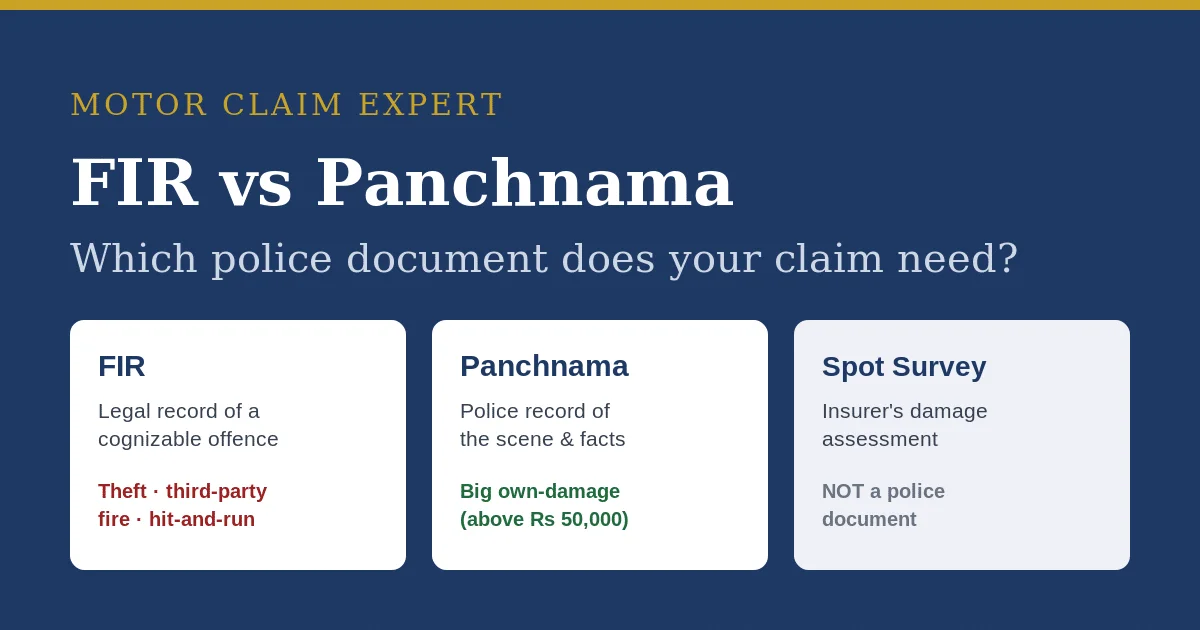
After an accident, one question causes more confusion — and more rejected claims — than almost any other: do I need an FIR, a panchnama, both, or neither? The words get used interchangeably, but they are three different things, prepared by different people, for different reasons. Getting them mixed up is how a genuine own-damage claim ends up short of the one police record the insurer wanted.
This guide separates them cleanly: what each document actually is, which one your situation needs, and the trap of confusing a police panchnama with the surveyor’s spot survey. It complements our detailed guide to when an FIR is mandatory and the claim documents checklist.
Three different documents — don’t confuse them
| Document | What it is | Prepared by |
|---|---|---|
| FIR (First Information Report) | A formal police record of a cognizable offence — registers the incident in law. | Police, at the station (or online for some cases) |
| Panchnama | A police document recording the facts and scene of the incident in the presence of independent witnesses (panch). It can exist even without an FIR. | Police, often at the spot |
| Spot survey / surveyor’s report | The insurer’s assessment of the damage — an insurance document, not a police record. | IRDAI-licensed surveyor appointed by the insurer |
The single most common mistake is treating the surveyor’s spot inspection as if it were a panchnama. It is not. The surveyor’s report establishes the cost and cause of damage for the insurer; a panchnama is a police record of the scene. A large own-damage claim may need both — a police panchnama for the incident and a surveyor’s report for the assessment.
When you need an FIR
An FIR is required whenever there is a criminal or third-party element: third-party injury or death, damage to someone else’s property, theft, hit-and-run, fire, riot, vandalism or malicious damage. Here the FIR is not optional — it is the document that legally establishes the event, and its absence is a standard ground for rejection. For a stolen vehicle you also need the police’s final “untraced” report before the claim is settled.
When you need a panchnama (and an FIR may not be required)
For a single-vehicle, own-damage accident — you skid into a divider, hit a pothole, or scrape a wall — an FIR is usually not mandatory. But that does not mean “no police record.” For own-damage above roughly ₹50,000, most insurers ask for an accident report or police panchnama even when no FIR is needed, because a larger claim needs an independent record of how the damage occurred. The threshold and exact requirement vary by insurer, so confirm at intimation.
Ask your insurer before you decide to skip the police. A missing panchnama or FIR is very hard to obtain days later — the scene is gone and memories fade. When in doubt on a larger claim, get the police record. It is far easier to have one you didn’t strictly need than to reconstruct one you did.
Which does your situation need? (decision guide)
| Situation | FIR? | Panchnama? |
|---|---|---|
| Minor own-damage scrape (below ~₹50k) | No | Usually not — confirm with insurer |
| Major own-damage, single vehicle (above ~₹50k) | Often not | Yes — insurer typically requires it |
| Third-party injury / death / property damage | Yes | Yes (records the scene) |
| Theft or total loss | Yes + untraced report | Yes |
| Hit-and-run, fire, riot, vandalism | Yes | Yes |
How to obtain each
For an FIR, report at the police station with jurisdiction over the accident site; many states also allow online FIRs for certain incidents. For a panchnama, the police record it — usually at the spot — noting the vehicle’s position, visible damage and the circumstances, with independent witnesses. Ask for a certified copy of whichever is prepared, and keep it with your claim documents. When you fill the claim form, describe the incident in your own words — do not simply write “as per police report.”
The mistakes that turn this into a rejection
- No police record when the insurer required one. Skipping a panchnama on a large own-damage claim, or an FIR on a theft/third-party case, is a direct rejection ground.
- Confusing the surveyor’s survey with a panchnama. The survey is not a substitute for a police record where one is needed.
- Inconsistency. If the FIR, panchnama, claim form and physical damage tell different stories, the claim is questioned — and can be treated as misrepresentation.
- Delay. A police record filed days late, like late intimation, invites suspicion. Report promptly.
- Repairing before the survey. Even a perfect police file can’t save a claim where the damage was repaired before the surveyor inspected it.
Get this right and the police paperwork does exactly what it should: it corroborates a genuine loss and removes the insurer’s excuse to doubt it. Get it wrong, and a valid claim stalls over a document that took thirty minutes to obtain on the day.
For a stolen vehicle you need the FIR and the police untraced report — see the full car theft insurance claim process.
Frequently Asked Questions — FIR vs Panchnama in a Motor Claim
What is the difference between an FIR and a panchnama?
An FIR is a formal police record of a cognizable offence that registers the incident in law. A panchnama is a police document that records the facts and scene of the incident in the presence of independent witnesses. A panchnama can be prepared even where no FIR is registered, and insurers often accept it as the police record for own-damage claims.
Is a panchnama the same as the surveyor’s spot inspection?
No. A panchnama is a police document about the scene. The spot survey is the insurer’s own damage assessment, carried out by an IRDAI-licensed surveyor. They are different documents from different parties, and a large claim may need both.
Do I need an FIR for a single-car own-damage accident?
Usually not — an FIR is generally not mandatory for a single-vehicle, own-damage-only accident. However, for damage above roughly ₹50,000 most insurers still ask for an accident report or police panchnama, so confirm the requirement when you intimate the claim.
When is an FIR compulsory for a car insurance claim?
Whenever there is a criminal or third-party element: third-party injury or death, damage to another’s property, theft, hit-and-run, fire, riot or vandalism. For theft, you also need the police’s final “untraced” report before settlement.
Can my claim be rejected if I don’t file a panchnama?
Yes, if the insurer required one. On a larger own-damage claim, skipping the police panchnama the insurer asked for is a standard reason for rejection, because the insurer has no independent record of how the damage occurred.
How do I get a panchnama for my accident?
The police prepare it, usually at the accident spot, recording the vehicle’s position, visible damage and circumstances with independent witnesses. Ask for a certified copy and keep it with your claim documents.
Can I use a panchnama instead of an FIR?
For own-damage claims where an FIR is not mandatory, a police panchnama or accident report often suffices as the police record. But where an FIR is legally required — theft, third-party, hit-and-run — a panchnama does not replace it.
What if the FIR, panchnama and claim form don’t match?
Inconsistencies between your documents and the physical damage are a red flag and can be treated as misrepresentation. Tell one true, consistent account everywhere — in the FIR, the panchnama and the claim form.
Sources & official references
- Law: registration of a First Information Report is governed by the Bharatiya Nagarik Suraksha Sanhita, 2023, s.173 (formerly Code of Criminal Procedure, 1973, s.154).
- Policy wording: prompt FIR/intimation requirements are set by your insurer’s standard motor policy wording (IRDAI-approved product).
- Investigative practice: a panchnama is a procedural record drawn up by the police/surveyor at the scene — it is an evidentiary practice, not a statutory document.


