
The motor insurance claim form looks like a formality. It is not. It is a signed legal declaration, and the surveyor and claims officer read every line of it against your documents. A form that contradicts your FIR, understates the driver, or leaves the wrong box blank can turn a valid claim into a rejected one — not because the loss wasn’t covered, but because the paperwork didn’t hold together.
This guide walks through the form section by section, explaining what each field is really asking, which document it must match, and the specific entries that quietly sink claims. It pairs with our claim documents checklist and the full claim process guide.
Before you write a word: intimate first
Most insurers expect you to report the incident within 24–48 hours and issue a claim number before the form is even submitted. The date you fill in as “date of intimation” is checked against when the loss actually happened — a gap of several days with no explanation is one of the most common triggers for the late-intimation objection. Intimate first, note the claim number, then complete the form calmly.
Section-by-section: what each field really asks
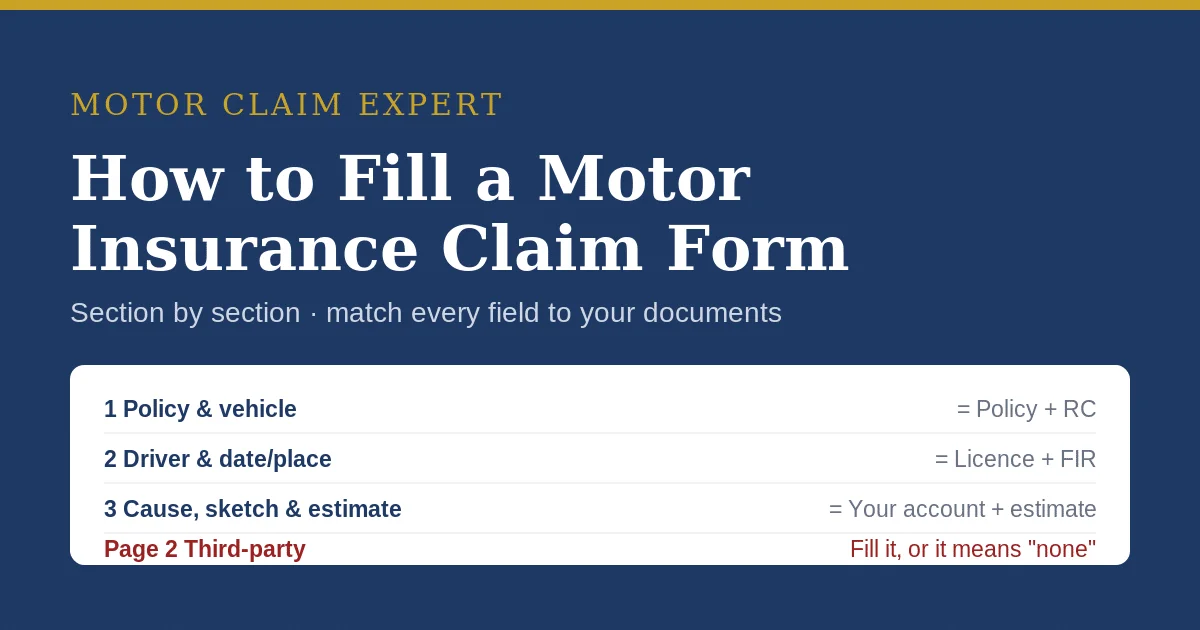
| Section | What to enter — and the document it must match |
|---|---|
| Policy & contact details | Policy/cover-note number, name and phone exactly as on the policy schedule. A mismatch here delays everything. |
| Vehicle details | Registration number, make/model, engine & chassis number — must match the RC. Note any CNG/LPG kit or modification honestly. |
| Driver details | The person actually driving at the time, with a valid licence number and class — must match the driving licence. Never enter a “convenient” driver. |
| Date, time & place of loss | Precise and consistent with the FIR/panchnama and your intimation. Vague or conflicting timings invite scrutiny. |
| Cause & description of accident | A factual narration of how it happened. Write what occurred — do not write “as per police report”; the insurer needs your own account. |
| Sketch of the accident | A simple diagram of vehicle positions and direction — small effort, but it corroborates your narration. |
| Estimated loss (in ₹) | A realistic estimate, ideally aligned with the garage repair estimate. Inflated figures reduce trust in the whole file. |
| Garage / repair details | Network garage for cashless, or your chosen garage for reimbursement. |
| Declaration & signature | A legal statement that the information is true. This is what converts an error into misrepresentation. |
The “Page 2” trap: third-party details
Most motor claim forms have a second page for third-party injury, death or property damage. If your accident involved another person or vehicle, this page must be completed. Leaving it blank is not neutral — insurers treat an empty third-party section as a declaration that there were no third-party consequences. If a third-party claim later surfaces, that blank page becomes a contradiction in your own file. If anyone else was involved, record the details; if truly no one was, that is fine, but know that the blank is being read as a statement.
The one sequence that protects your claim: intimate → let the surveyor inspect → then repair. Starting repairs before the surveyor’s inspection destroys the evidence the form describes, and is a standard ground for rejection regardless of how well the form is filled.
The five entries that quietly get claims rejected
- An inconsistent cause of loss. If the form’s narration contradicts the FIR or the physical damage, the claim is questioned. Tell one true story everywhere.
- The wrong driver. Naming someone other than the actual driver — or a driver without a valid licence for that vehicle — is a classic repudiation trigger and can amount to a driver-statement problem.
- A date/time that doesn’t add up. Loss date, intimation date and FIR date should form a coherent timeline.
- Undeclared modifications. An undeclared CNG/LPG kit or structural change on a form that says the vehicle is standard is a direct contradiction.
- An inflated estimate. A figure far above the survey invites suspicion and slows the whole claim.
After you submit
Keep a signed copy of the completed form and every attachment, and get an acknowledgement with your claim number. The surveyor will assess the damage and the insurer will sanction an amount; if that amount is unfairly low, do not sign the discharge voucher in “full and final settlement” without noting your protest. A cleanly filled form plus a complete document file is exactly what gives you standing if you later need to reply to a repudiation or escalate to the consumer court.
The police record you reference on the form matters too — see FIR vs panchnama: which does your claim need.
Your KYC must match the details on the form and the RC — our guide to KYC for motor claims explains why mismatches cause delays.
Frequently Asked Questions — Filling the Motor Insurance Claim Form
How do I fill a motor insurance claim form correctly?
Fill each section to match your documents: policy details from the schedule, vehicle details from the RC, the actual driver’s valid licence, a precise date/time/place consistent with the FIR, a factual narration of the cause, a realistic loss estimate aligned with the garage bill, and a signed declaration. Complete the third-party page if anyone else was involved, and keep a signed copy.
What should I write in the “cause of accident” section?
Write a clear, factual account of what actually happened in your own words. Do not write “as per police report” or leave it vague — the insurer needs your own description, and it must be consistent with the FIR and the visible damage.
Do I need to fill the second page of the claim form?
Yes, if there was any third-party injury, death or property damage. Insurers treat a blank third-party section as a declaration that there were no such consequences, so leaving it empty when a third party was involved creates a contradiction in your file.
What is the most common mistake on a claim form?
Inconsistency — a cause of loss, date, driver or vehicle detail on the form that does not match the FIR, the RC or the licence. The single behavioural mistake that sinks the most claims is starting repairs before the surveyor inspects the vehicle.
Can a wrongly filled claim form get my claim rejected?
Yes. The form is a signed declaration. False, inconsistent or missing information — especially about the driver, the cause, or undeclared modifications — can be treated as misrepresentation and used to repudiate an otherwise valid claim.
Should I fill the form before or after informing the insurer?
Inform the insurer first, within 24–48 hours, and get a claim number. Then complete the form. The intimation date on the form is checked against when the loss occurred, so early reporting protects you from the late-intimation objection.
What documents should match the claim form?
The policy schedule (policy details), the RC (vehicle details), the driving licence (driver details), the FIR or panchnama (date, time, place and cause), and the garage estimate (loss amount). See our claim documents checklist for the full list by claim type.
What should I do after submitting the form?
Get an acknowledgement and claim number, keep a signed copy of the form and all attachments, and let the surveyor inspect before repairs. If the sanctioned amount is unfairly low, note your protest before signing the discharge voucher rather than accepting it as full and final.


