
Insurance is a contract of utmost good faith — in law, uberrima fides. That places an unusually heavy duty on you: what you write on the proposal form, and what you leave out of it, can decide a claim years later. A claim rejected “for misrepresentation” or “non-disclosure of a material fact” traces back to that form, not to the accident.
But not every omission is fatal. The rejection turns on one word — material — and on a hard line between an innocent slip and deliberate fraud. This guide explains where that line sits, the motor misrepresentations that actually void claims, the trap that makes motor policies more exposed than life policies, and what to do if you have been rejected on this ground.
The doctrine: what “utmost good faith” actually requires
You must disclose every material fact when you take the policy. The Supreme Court, in Satwant Kaur Sandhu v. New India Assurance Co. Ltd., (2009) 8 SCC 316, defined a material fact as “any fact which would influence the judgment of a prudent insurer in fixing the premium or determining whether he would like to accept the risk” — anything that “goes to the root of the contract.” Critically, the Court held it is not for the proposer to decide what is material: if the form asks, you are under a solemn obligation to answer fully and truthfully.
The motor misrepresentations that actually void claims
| Misrepresentation | Why it can sink the claim |
|---|---|
| Insuring a commercially used vehicle as private | Use changes the risk and the premium — a classic material misstatement. |
| Not disclosing prior major accidents or claims | Claim history is material to how the insurer prices and accepts the risk. |
| Fronting — hiding the real owner or main driver | Insuring a young driver’s car in a parent’s name to cut the premium misstates who bears the risk. |
| A fake or inflated no-claim bonus | Claiming an NCB you are not entitled to is a direct misstatement insurers now verify. |
| Wrong vehicle, engine or variant details | Misdescribing the insured vehicle undermines the whole contract. |
The motor-specific trap: no three-year shield
Life-insurance policyholders have a powerful protection: Section 45 of the Insurance Act, 1938 bars an insurer from questioning a life policy after three years, on any ground including misstatement or fraud. Motor owners do not have this. The Supreme Court confirmed in Satwant Kaur Sandhu that Section 45 applies only to life insurance — it does not protect general or motor policies at all. The practical consequence is stark: a motor policy can be challenged for a material misrepresentation at any time, including at the claim stage, years after it was taken. The proposal form never goes stale.
Where the line sits: innocent, material, or fraud
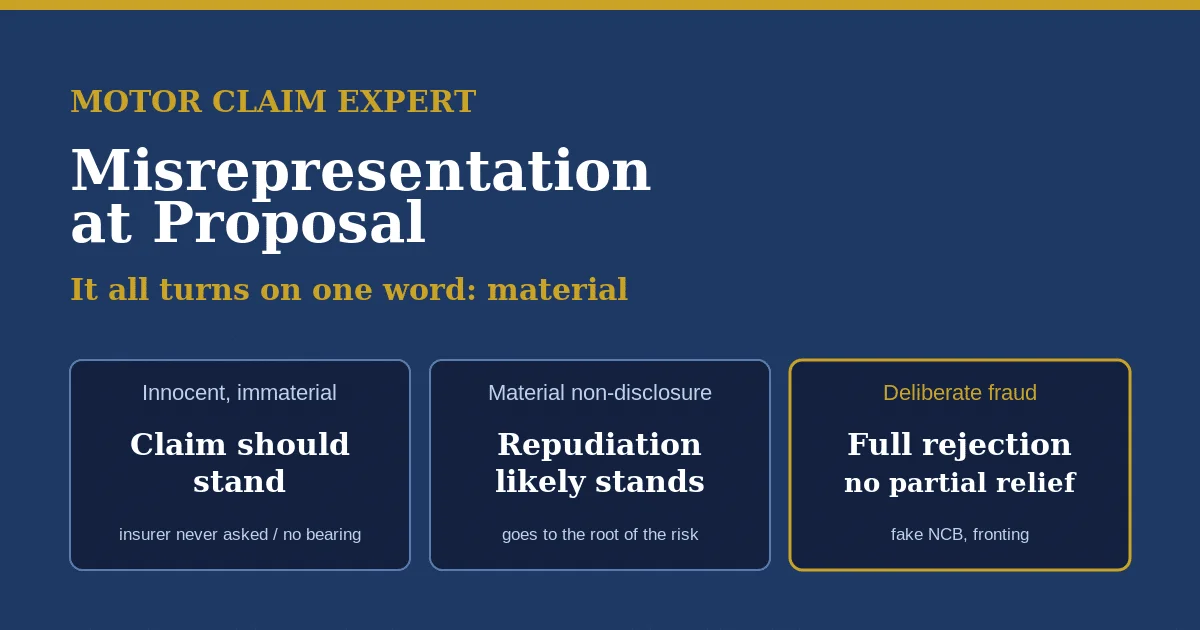
Three very different situations get lumped together as “misrepresentation,” and the outcome depends entirely on which one you are in:
| Situation | Likely outcome |
|---|---|
| An innocent, immaterial slip the insurer never asked about | Should not defeat the claim — argue materiality and nexus. |
| A material non-disclosure that goes to the root of the risk | Repudiation likely stands (Satwant Kaur Sandhu). |
| Deliberate fraud — fake NCB, staged history, fronting | Full repudiation; the “non-standard” relief does not apply. |
This is the mirror image of the non-standard settlement principle. There, a breach not connected to the loss earns a partial (often 75%) payout. Here, a material misrepresentation at the very formation of the contract — especially a deliberate one — is the fundamental breach where that partial relief is not available. Fraud sits at the opposite pole from a technical lapse.
What the insurer must still prove
A misrepresentation defence is not a free pass. Even here the insurer must give you the repudiation in writing with reasons, and the burden is on the insurer to show that the fact was actually asked, was material, and was misstated or concealed. If the proposal form never sought the information, or the fact would not have influenced a prudent insurer, a rejection can be challenged. An insurer cannot simply label a claim “misrepresentation” and walk away.
If your claim was rejected on this ground
Work through three questions before you concede: was the fact actually asked on the proposal form; was it genuinely material to the risk; and was any error innocent rather than deliberate? If the answers favour you, reply in writing putting the insurer to proof of materiality, and escalate to the Insurance Ombudsman if it holds firm. The same discipline that helps with a late-intimation rejection applies: make the insurer prove the ground rather than accepting the label.
Myth versus reality
| What you assume | What is true |
|---|---|
| “After a few years the policy can’t be questioned.” | That three-year shield is Section 45 — life insurance only. Motor policies have no such time bar. |
| “Any small mistake voids the policy.” | Only a material misstatement does; an immaterial slip the insurer never asked about should not. |
| “The insurer can just say ‘misrepresentation’.” | The insurer must prove the fact was asked, material, and misstated — in writing. |
| “Fronting or a fake NCB is a harmless saving.” | Both are deliberate misrepresentations that can void the claim entirely, with no partial relief. |
The bottom line
A misrepresentation rejection lives or dies on materiality. An innocent, immaterial omission should not cost you a genuine claim, and the insurer must prove its case in writing. But a material non-disclosure that goes to the root of the risk — and above all a deliberate fraud like a fake NCB or fronting — is the one rejection ground where the law offers little sympathy and no partial payout. Motor owners are especially exposed because the three-year shield that protects life policies simply does not apply. Fill the form honestly, and the problem never arises.
Frequently asked questions
Much of this starts on the claim form: an inaccurate driver, cause or vehicle entry is exactly what turns an error into misrepresentation.
Two other grounds insurers lean on are alcohol and licence. See whether a claim can be rejected for drunk driving or driving without a valid licence — and why it is not automatic.
What does ‘misrepresentation’ mean in a car insurance claim?
It means you stated something untrue, or failed to disclose a material fact, when taking the policy. Insurance is a contract of utmost good faith (uberrima fides), so a material misstatement on the proposal form — about use, prior claims, the real owner or driver, or the no-claim bonus — can let the insurer repudiate the claim.
What is a ‘material fact’ in insurance?
The Supreme Court in Satwant Kaur Sandhu v. New India Assurance, (2009) 8 SCC 316, defined it as any fact that would influence a prudent insurer in fixing the premium or deciding whether to accept the risk — anything that goes to the root of the contract. If the proposal form asks about it, you must disclose it fully; it is not for you to decide it is unimportant.
Can a motor policy be questioned years after it was taken?
Yes. Section 45 of the Insurance Act, 1938 bars insurers from questioning a policy after three years, but it applies only to life insurance. It does not protect general or motor policies, so a motor policy can be challenged for a material misrepresentation at any time, including at the claim stage.
Will any small mistake on the proposal form void my claim?
No. Only a material misstatement — one that would have influenced the insurer’s decision or premium — can void a claim. An innocent, immaterial slip the insurer never asked about should not defeat a genuine claim, and the insurer must prove the fact was asked, material and misstated.
What is fronting, and why is it a problem?
Fronting is hiding the real owner or main driver — for example insuring a young driver’s car in a parent’s name to get a lower premium. It misstates who actually bears the risk, so it is a deliberate misrepresentation that can void the claim entirely, with no partial (non-standard) relief.
Is claiming a fake no-claim bonus (NCB) risky?
Yes. Claiming an NCB you are not entitled to is a direct misstatement, and insurers now verify NCB with the previous insurer. A false NCB is treated as deliberate fraud and can lead to full repudiation of the claim, not just a loading of premium.
How is misrepresentation different from an undeclared CNG kit?
An undeclared CNG kit is a non-disclosure, but if the loss had no connection to the kit, courts often still award a non-standard settlement. A material misrepresentation at the formation of the contract — especially a deliberate fraud — goes to the root of the risk, so full repudiation stands and the partial relief does not apply.
My claim was rejected for misrepresentation — what can I do?
Check three things: was the fact actually asked on the proposal form, was it genuinely material, and was any error innocent rather than deliberate? If the answers favour you, reply in writing putting the insurer to proof of materiality, and escalate to the Insurance Ombudsman if it holds firm. The insurer must give written reasons and prove its case.
Sources & official references
- Principle: insurance is a contract of utmost good faith (uberrima fides); a claim can be avoided for the misrepresentation or non-disclosure of a material fact at the proposal stage.
- Law: Section 45 of the Insurance Act, 1938 bars an insurer from questioning a life policy after three years — a protection specific to life insurance; motor claims turn on the general materiality and good-faith principle, not this three-year bar.
- Policy wording: the proposal-form declaration in your IRDAI-approved motor policy wording.


