
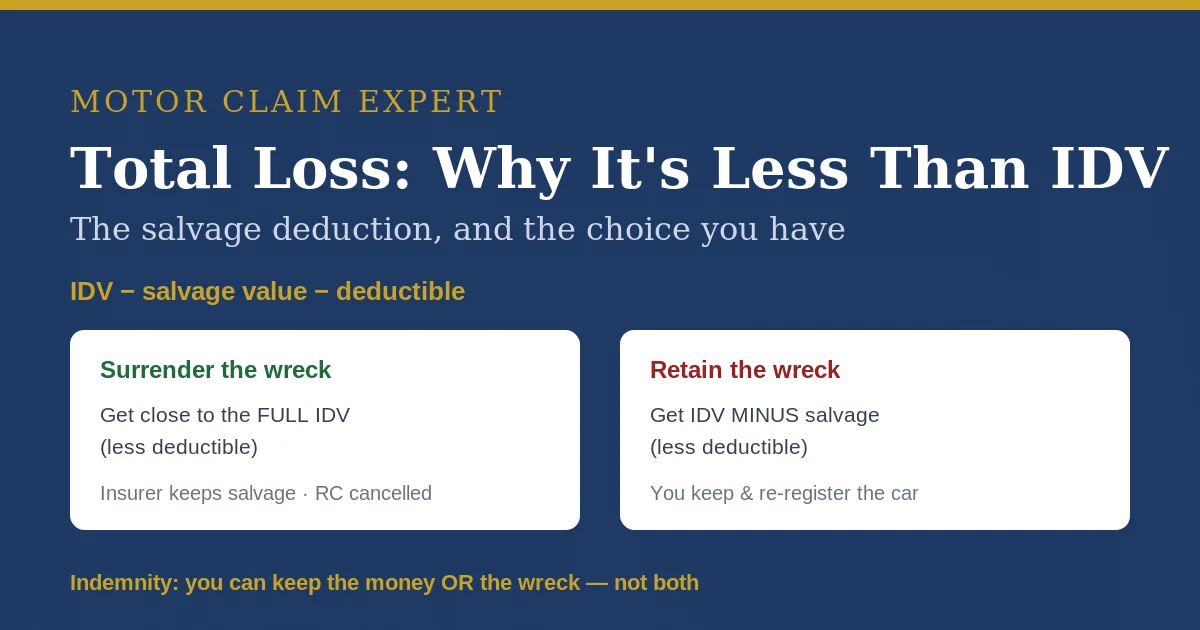
Short answer: when your car is declared a total loss, the insurer does not simply hand you the full Insured Declared Value. What you receive depends on who keeps the wreck. If you let the insurer take the salvage, you get close to the full IDV (less your deductible) and the car’s registration is cancelled. If you keep the wreck, its salvage value is deducted — so your cheque is IDV minus salvage minus deductible. That salvage deduction is the main reason a total-loss payout feels smaller than the IDV you thought you were insured for.
This guide explains exactly how the salvage deduction works, the choice between surrendering and retaining the wreck, how the salvage figure is set, and when keeping the wreck is worth it. It builds on our guides to total loss and the 75% CTL rule and how IDV is calculated.
How a total-loss claim is actually settled
A car is treated as a total or constructive total loss when the cost of repair crosses about 75% of its IDV. At that point the claim is no longer about repairs — it is settled against the IDV. But the standard motor policy wording settles a total loss at the IDV reduced by the value of the wreck, and your compulsory deductible is taken off as well. So the base formula is: IDV − salvage value − deductible. Whether the salvage line actually reduces your cheque depends on the route you choose.
The two settlement routes
| Route | What you receive | What happens to the car |
|---|---|---|
| Surrender the salvage (most common) | Close to the full IDV, less only the deductible | The wreck goes to the insurer, who sells it as salvage. The registration (RC) should be cancelled/deregistered. |
| Retain the salvage | IDV minus the agreed salvage value, less the deductible | You keep the wreck (you effectively “buy it back” at the salvage value) and remain its registered owner. |
Both routes are consistent — in the first you give up the wreck and keep the money; in the second you keep the wreck but the money is reduced by what the wreck is worth. What you cannot do is keep the full IDV and the wreck.
Why salvage is deducted at all
The reason is the principle of indemnity, which underlies every general-insurance claim in India: the policy is meant to restore you to roughly the same financial position you were in before the loss — neither worse off nor better off. If the insurer paid you the full IDV and let you keep a wreck you could sell for parts or scrap, you would end up better off than before. Deducting the salvage value when you retain the wreck is simply the mechanism that keeps the settlement to your actual net loss.
How the salvage value is decided
The salvage figure is assessed by the surveyor, usually by inviting bids from salvage or scrap buyers and taking the best realistic offer as the wreck’s value. It depends heavily on the wreck’s condition — how much of the body, engine, gearbox and reusable parts survived, and current scrap and used-parts demand. It is not a token amount: on a badly damaged car it can still be a meaningful share of the IDV, which is exactly why retaining the wreck reduces the payout noticeably. Because it is a valuation, you can ask to see how it was arrived at and question it if it looks unreasonably high (a high salvage value shrinks your cheque when you retain the wreck).
A worked example
Suppose your car’s IDV is ₹6,00,000, the surveyor fixes the salvage value at ₹80,000, and your compulsory deductible is ₹1,000:
• Surrender the salvage: you receive about ₹6,00,000 − ₹1,000 = ₹5,99,000, and the insurer keeps the wreck.
• Retain the salvage: you receive ₹6,00,000 − ₹80,000 − ₹1,000 = ₹5,19,000, and you keep the wreck.
The ₹80,000 gap is the value of the wreck you chose to keep — not money the insurer has “cut” unfairly.
Should you keep the wreck?
Retaining the salvage only makes sense if the wreck is genuinely worth more to you than the salvage value deducted — for example, if you have a real buyer, a use for the parts, or a way to rebuild it economically. For most owners, surrendering the wreck and taking close to the full IDV is simpler and cleaner. Weigh a few things before deciding:
- Re-registration and roadworthiness. A rebuilt total-loss car can be difficult and costly to make road-legal and safe, and it carries the same hidden-damage risks buyers face with flood and salvage-history cars.
- A financed car. If there is a loan, the financier’s dues are usually settled from the claim first, and you will need the financier’s consent on the settlement route and any salvage retention.
- Resale honesty. If you rebuild and later sell, the car’s total-loss history is a material fact — not disclosing it can create disputes down the line.
The registration point people miss
When the insurer takes the salvage, the car’s registration is meant to be cancelled/deregistered so the wreck is not quietly repaired and put back on the road under its old identity. This matters for the whole used-car market, and it is why a salvaged car should never re-enter circulation as an ordinary vehicle. If you retain the salvage instead, you stay the registered owner and take on the responsibility of getting it properly repaired and re-certified before any use. Either way, keep the settlement letter and the salvage valuation on record.
Beyond the payout, a write-off hits your discount too. See what happens to your NCB after a total loss.
Salvage is one deduction among several. For the whole set — depreciation, deductible, consumables and more — see every deduction on your repair bill, explained.
Frequently Asked Questions — Salvage Value Deduction
Why is my total-loss payout less than my IDV?
Because a total loss is settled at IDV minus the value of the wreck, minus your deductible. If you keep the wreck, its salvage value is deducted from your payout. If you surrender the wreck to the insurer, you receive close to the full IDV less only the deductible.
What is salvage value in a car insurance claim?
It is the assessed worth of the damaged vehicle — what the wreck could be sold for as parts or scrap. The surveyor usually determines it from salvage-buyer bids. It is deducted from your settlement when you choose to retain the wreck rather than hand it to the insurer.
Can I keep my car after a total loss?
Usually yes, by retaining the salvage. You then receive the IDV minus the agreed salvage value (and the deductible) and remain the registered owner. It only makes sense if the wreck is worth more to you than the salvage value that is deducted.
Do I get the full IDV if the insurer keeps the car?
You get close to it — the full IDV less your compulsory (and any voluntary) deductible. In return you surrender the wreck, and the registration should be cancelled.
How is the salvage value calculated?
The surveyor assesses it, typically by obtaining bids from salvage or scrap dealers and taking the best realistic offer. It varies with the wreck’s condition and the value of reusable parts, so there is no fixed percentage. You can ask to see how it was arrived at.
Is salvage deducted even if I don’t want to keep the car?
No. If you surrender the wreck to the insurer, the salvage value is not deducted from your cheque — the insurer recovers it by selling the salvage itself. The deduction applies only when you retain the wreck.
What happens to the registration after a total loss?
If the insurer takes the salvage, the RC should be cancelled/deregistered so the wreck cannot be improperly re-registered. If you retain the salvage, you stay the registered owner and are responsible for getting the vehicle properly repaired and re-certified before use.
What if my car is financed?
The financier’s outstanding dues are generally settled from the claim first, and you will need the financier’s consent on the settlement, including any decision to retain the salvage. Only the balance, if any, comes to you.
Sources & official references
- Policy wording: a total loss is settled at the Insured Declared Value “less the value of the wreck” under your insurer’s IRDAI-approved motor policy wording.
- Standard term: a vehicle is treated as a constructive total loss where the aggregate repair cost exceeds 75% of the IDV (India Motor Tariff, General Regulation 8).
- Legal principle: the deduction reflects the principle of indemnity — the insured is restored to the pre-loss position, neither better nor worse off.


