
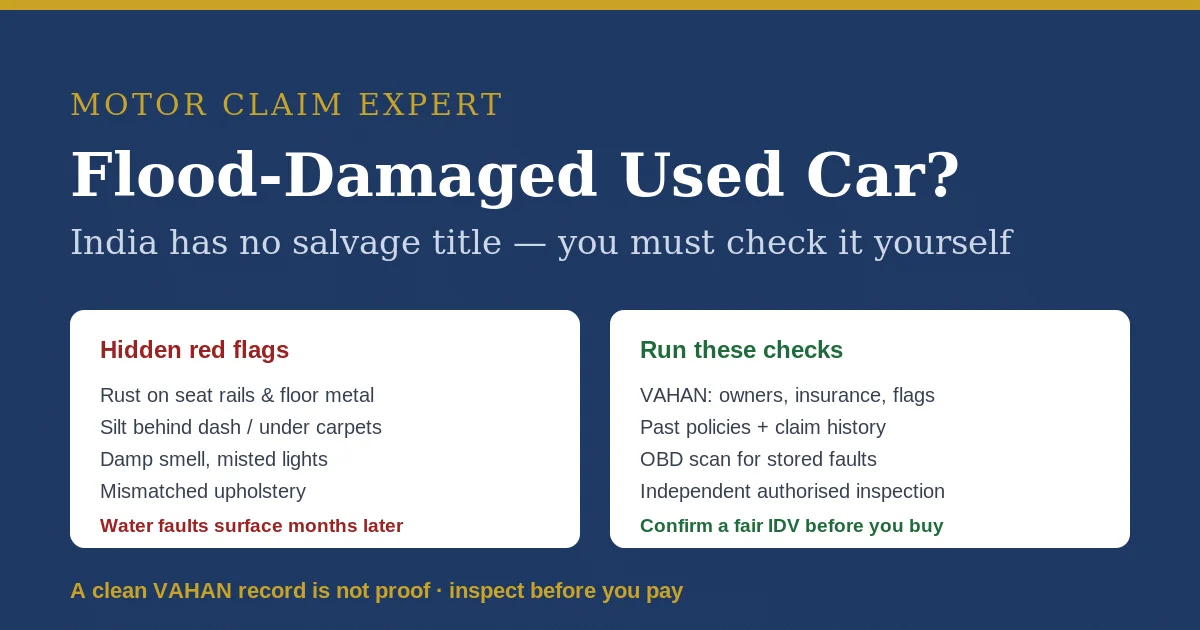
Short answer: every monsoon, cars written off by insurers as flood total-losses are dried out, cleaned up and quietly resold — and India has no mandatory “salvage” or “flood” title to warn you. A flood-damaged car can look spotless and still hide corroded wiring and a fried ECU that fail months later. The risk is not only mechanical: a rebuilt flood car can be harder to insure at a fair value, and a future claim for its recurring electrical or water-related faults can be reduced or rejected. So the checks below are your only real protection — the paperwork does not do it for you.
This guide is written from the claims side. Plenty of articles tell you to sniff for damp and look for rust. Fewer explain why these cars exist in the first place, what a flood past does to your insurance and claims, and what you can actually verify before you pay. It builds on our guides to total loss and CTL and flood claims.
Why flood cars reappear every monsoon
When a car is submerged and the repair estimate crosses about 75% of its Insured Declared Value, the insurer generally treats it as a constructive total loss: it pays the IDV and takes the wreck as salvage. That salvage is then sold on. Somewhere down the chain it can be repaired, valeted and put back on the used market — often in a different city — looking far better than it should.
Two things make this worse in India. First, the registration certificate of a totalled car is not always cancelled when the salvage is sold, so on paper the vehicle can still look like an ordinary used car. Second, a large share of used-car deals still happen through informal channels — local brokers and direct owner-to-owner sales — where a seller who simply dried out a waterlogged car and never filed a claim leaves no paper trail at all. That second category is the hardest to catch, because there is no insurer record to find.
The India problem: no salvage title, no duty to tell you
In some countries a car that has been totalled carries a permanent “salvage” or “flood” brand on its title, so any buyer can see the history at a glance. India has no equivalent system. There is no mandatory flood-history brand, and generally no legal duty on a private seller to volunteer that a car was once submerged. That means you cannot rely on the documents to protect you — the absence of a warning is not proof the car is clean. Treat every used car bought during or just after monsoon as needing a deliberate history check, not a hopeful one.
The paperwork checks to run before you pay
None of these is foolproof on its own, but together they narrow the risk considerably:
| Check | What it can tell you |
|---|---|
| VAHAN record (Parivahan / mParivahan) | Registration status, number of previous owners, insurance validity, road tax, and any hypothecation or blacklist flag. A prior total-loss can sometimes surface as a status flag — but not reliably, so absence of a flag proves nothing. |
| Insurance & claim history | Ask for the current policy and past policies. A sudden change of insurer, a gap in coverage, or a fresh policy on an older car can hint at a past claim. You can ask the seller to obtain a claim-history/NCB confirmation from the insurer. |
| Owner count vs age | An unusually recent transfer, an out-of-state registration, or several quick owner changes after a known flood event deserve a closer look. |
| Service records | Repeated wiring, sensor, ECU or upholstery work clustered around one date is a strong red flag. |
| Independent inspection | A paid inspection at an authorised workshop, including an OBD scan for stored fault codes, is the single most useful spend before buying an older car in monsoon season. |
Physical red flags an inspection should catch
Flood damage is usually hidden under a good clean-up, so look where valeting does not reach: corrosion on seat rails, floor brackets and under-seat metal; silt or fine sand behind the dashboard, inside the glovebox or under carpets; a persistent damp or mildew smell from the vents; misted headlights or tail-lights; and upholstery whose upper and lower halves do not quite match in colour. An OBD scan matters because water-damaged cars often store a history of electrical faults even after visible repairs. If the seat rails have unusual rust and the boot spare-wheel well shows a water line, walk away regardless of how well the cabin presents.
The insurance and claim risks nobody warns you about
This is where a flood car costs you twice. Even if it drives well at first, the ownership and claims consequences can be serious:
- Valuation and insurability. For a car more than about five years old, IDV is negotiated between you and the insurer. A vehicle with a doubtful past may attract a lower IDV, closer scrutiny, or a reluctant insurer — so your cover and any future total-loss payout can be worth less than you expect.
- Recurring water faults may not be paid. Corrosion and electrical failures that trace back to the original submersion can be treated as pre-existing damage or gradual deterioration rather than a fresh, sudden accident — and consequential or wear-and-tear losses are commonly excluded. Engine damage from water needs a separate Engine Protection add-on; the base policy usually will not cover it.
- Material non-disclosure risk. If a car’s flood or total-loss history is a material fact and it is not disclosed when you insure it, an insurer that later discovers it can dispute a claim. The principle behind many misrepresentation and non-disclosure rejections can apply here too, depending on the facts and the policy wording.
- Resale and finance. A car with a discoverable flood past is harder to sell on and can be difficult to finance, so the “bargain” price often reflects a real loss you inherit.
None of this is a guaranteed outcome — much depends on the policy wording, the cause of the specific failure, and the evidence. But the pattern is consistent enough that a flood car should never be bought on price alone.
A buyer’s protection checklist
Before you commit to any used car this monsoon:
1. Pull the VAHAN record and match owner count, state and insurance validity against what the seller told you.
2. Ask for all past policies and a claim/NCB history, and be wary of a fresh policy or an insurer switch on an older car.
3. Get an independent inspection with an OBD scan at an authorised workshop — not the seller’s garage.
4. Inspect the hidden metal and cavities (seat rails, floor, spare-wheel well) and do the smell test with the AC off, then on.
5. If anything points to a flood past, either walk away or price in a full electrical overhaul — and confirm you can insure it at a fair IDV first.
If you suspect you already bought one
If faults appear and you believe the car’s flood history was hidden, get a dated independent inspection report documenting the water damage — it is your evidence. Where a seller or dealer actively misrepresented the car’s condition, that can be a basis to seek a refund, repair or compensation, and an unresolved dispute with a dealer can be taken to the consumer commission. Separately, tell your own insurer the facts you now know; carrying an accurate picture on your policy protects your next claim, even if it means renegotiating the IDV. Whether any particular remedy succeeds depends on the evidence and how the sale was made, so keep every document from the purchase.
These cars enter the market as insurer salvage. For how that salvage is valued and deducted at settlement, see salvage value deduction in a total-loss claim.
Frequently Asked Questions — Flood-Damaged Used Cars
Does India have a salvage or flood title like the US?
No. India has no mandatory “salvage” or “flood” brand on a vehicle’s title, and generally no legal duty on a private seller to disclose that a car was submerged. Because the absence of a warning does not prove a car is clean, you have to run your own history and physical checks before buying.
How can I check if a used car was flood damaged?
Combine a VAHAN record check (owner count, insurance validity, status flags), a request for past policies and claim history, and an independent workshop inspection with an OBD scan. Physically, look for hidden rust on seat rails and floor metal, silt behind the dashboard, a damp smell, misted lights, and mismatched upholstery.
Will a total loss show up on VAHAN?
Sometimes. A prior insurer total-loss can surface as an insurance or status flag, but it is not guaranteed — many flood cars never went through a claim, and a totalled car’s registration is not always cancelled. So a clean VAHAN record reduces suspicion but does not confirm the car is undamaged.
Can I insure a car that was previously a flood total loss?
Often yes, but expect closer scrutiny. For cars over about five years old the IDV is negotiated, and a doubtful history can mean a lower IDV or a more cautious insurer. Disclose what you know — carrying accurate facts on the policy protects your future claims.
Can my claim be rejected because the car had a hidden flood past?
It can, depending on the facts. Failures that trace back to the original submersion may be treated as pre-existing or consequential damage rather than a fresh accident, and undisclosed material history can let an insurer dispute a claim. Outcomes turn on the policy wording, the cause of the specific loss, and the evidence.
Is a flood-damaged car ever worth buying?
Only with eyes open. If an inspection is thorough, the price genuinely reflects a full electrical overhaul, and you have confirmed you can insure it at a fair value, some buyers accept the risk. For most people the hidden, recurring nature of water damage makes it a poor bargain.
What is the single most useful check?
An independent inspection at an authorised workshop that includes an OBD scan for stored fault codes. It reaches the hidden wiring and electronics that a valet cannot disguise, and it is inexpensive compared with the cost of a failed ECU or wiring loom later.


