
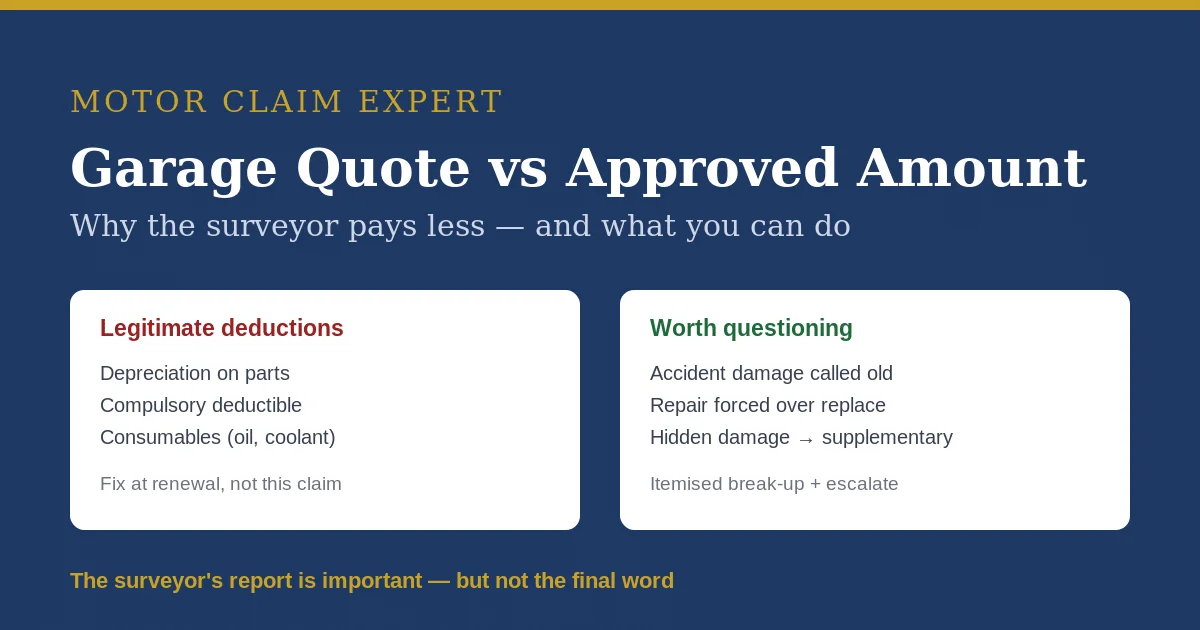
Short answer: the garage estimate is the full cost of putting your car right; the surveyor’s approved figure is what your policy actually pays. The two rarely match, because the approved amount comes after depreciation on parts, your deductible, unpaid consumables, aftermarket-rather-than-OEM part rates, and any items the surveyor treats as unrelated to the accident or over-priced. Much of that gap is legitimate — but not all of it, and the surveyor’s figure is not the last word. You can ask for an itemised break-up, dispute specific lines, and escalate.
This guide separates the parts of the gap you genuinely have to bear from the parts worth questioning, and shows how to push back. It builds on our guides to how surveyors assess car damage and the parts depreciation grid.
Why the two numbers are different by design
They are answering different questions. The garage estimates the repair cost — every part and hour needed to restore the car, usually at OEM part prices. The surveyor assesses the insurer’s liability — what the policy owes after applying its terms. So the surveyor reviews the garage estimate, strips out anything not caused by this accident or not covered, applies depreciation and the deductible, and approves the balance. A gap is therefore normal; the question is whether this gap is fair.
Where the gap comes from
| Reason the approved amount is lower | Legitimate? |
|---|---|
| Depreciation on parts — plastic, fibre, rubber and metal parts are paid after age-based depreciation; tyres and batteries often at ~50% | Yes, unless you have zero depreciation |
| Compulsory (and any voluntary) deductible | Yes — a fixed amount you always bear |
| Consumables — oil, coolant, nuts, bolts | Yes, unless you bought a consumables add-on |
| Aftermarket vs OEM part rates — insurer may assess at non-OEM prices | Sometimes — worth questioning on safety-critical parts |
| Repair instead of replace — surveyor allows a repair where the garage quoted a new part | Sometimes — question it if the part is structurally or safety-critical |
| Unrelated or pre-existing damage filtered out | Usually yes — but wrong if genuine accident damage is excluded |
| Rate/labour negotiation — surveyor approves market/network labour rates, not an inflated bill | Often yes — but question if labour is under-assessed for the actual work |
The deductions you genuinely bear
Some of the gap is simply how motor insurance works and is not worth disputing. Depreciation on replaced parts is applied by the standard grid unless you hold a zero-depreciation add-on; on an older car this alone can be a large share of a bumper or panel. The compulsory deductible is a fixed amount you bear on every own-damage claim, and consumables are excluded unless separately covered. If the reduction is made up mostly of these, the approved figure is probably correct — the fix for next time is buying the right add-ons, not disputing this claim.
The reductions worth questioning
Other reductions are judgement calls where you have room to push back:
- Genuine accident damage treated as pre-existing. If the surveyor has excluded damage that the accident actually caused, say so, with photos and the FIR or spot-survey notes.
- Repair forced where replacement is needed. For structural, safety or fitment-critical parts, a “repair” can be inadequate; a workshop note explaining why replacement is necessary carries weight.
- Labour or hours under-assessed for the actual work involved.
- Hidden damage found after dismantling. This is common — ask for a re-inspection and a supplementary estimate rather than accepting the first figure.
- Over-aggressive depreciation or wrong part rates applied beyond the standard grid.
What to do if you think the approved amount is too low
You are not stuck with the first number. A widely-cited Supreme Court ruling (New India Assurance Co. Ltd v. Pradeep Kumar) holds that a surveyor’s report is an important document but not final and binding — it must be given due weight, yet it can be challenged with sound reasons and evidence. In practice:
- Get the itemised break-up. Ask the insurer, in writing, for the survey/settlement sheet and compare it line by line with the garage estimate. A clear itemised gap is the basis for everything that follows.
- Put your disagreement in writing with the garage bills, photographs, and reasons for each disputed line — a written reply on the record matters more than a phone call.
- Ask for a re-inspection or supplementary where hidden or under-assessed damage is involved.
- Escalate if unresolved — a formal grievance, then the IRDAI Bima Bharosa portal, the Insurance Ombudsman, and finally the consumer commission, which can direct payment of a wrongly reduced amount with interest.
Keep expectations realistic: forums give a reasoned, compliant surveyor report due weight and will not overturn it without a solid reason. Your documents, photos and a clear itemised comparison are what make the difference.
How to narrow the gap next time
Much of the routine gap is avoidable at renewal, not at claim time. A zero-depreciation add-on removes the biggest line — parts depreciation — for a newer car; a consumables add-on covers oil and coolant; and choosing a cashless network garage aligns the estimate with the insurer’s approved labour and parts rates from the start, which reduces surprises. None of this changes the deductible, but together they shrink the shortfall between the bill and the cheque.
To separate legitimate deductions from questionable reductions, it helps to know them all — see every deduction on your repair bill, explained.
Frequently Asked Questions — Garage vs Surveyor Estimates
Why did the surveyor approve less than my garage’s estimate?
Because the garage quotes the full repair cost, while the surveyor approves only what the policy pays — after depreciation on parts, your deductible, unpaid consumables, non-OEM part rates, and any items treated as unrelated to the accident or over-priced. Some of this is legitimate; some is a judgement call you can question.
Is the surveyor’s assessment final?
No. A widely-cited Supreme Court ruling holds that a surveyor’s report is an important document but not final and binding. It is given due weight, but you can challenge it with garage bills, photographs and reasons, and escalate if the insurer does not reconsider.
Which reductions are legitimate and which can I dispute?
Depreciation on parts, the compulsory deductible and consumables are legitimate and usually not worth disputing. Reductions worth questioning include genuine accident damage excluded as pre-existing, a repair forced where replacement is needed, labour under-assessed, and hidden damage not yet surveyed.
Can I ask for a re-inspection if more damage is found?
Yes. Hidden damage often surfaces once the car is dismantled. Ask the insurer for a re-inspection and a supplementary estimate rather than accepting the original approved figure.
What documents do I need to challenge a low approval?
The itemised survey/settlement break-up, the garage’s detailed estimate and bills, dated photographs of the damage, and any FIR or spot-survey notes. Compare the two estimates line by line and put your disagreement in writing.
Does a cashless garage avoid this problem?
It reduces it. A network garage bills at the insurer’s agreed labour and parts rates, so the estimate and the approved amount are closer from the start. Depreciation and the deductible still apply.
Where do I escalate if the insurer won’t budge?
Start with a written grievance to the insurer, then the IRDAI Bima Bharosa portal, the Insurance Ombudsman, and finally the consumer commission. A reasoned, well-documented case is essential at every stage.
Sources & official references
- Supreme Court judgment: New India Assurance Co. Ltd v. Pradeep Kumar, (2009) 7 SCC 787 — a surveyor’s report is an important document but is not final or binding, and may be departed from where it is shown to be arbitrary or perverse.
- Law: assessment of loss by a licensed surveyor for claims of ₹20,000 or more is required under the Insurance Act, 1938, s.64UM.
- Policy wording: depreciation on parts and applicable deductions are set by your insurer’s IRDAI-approved motor policy wording.


