
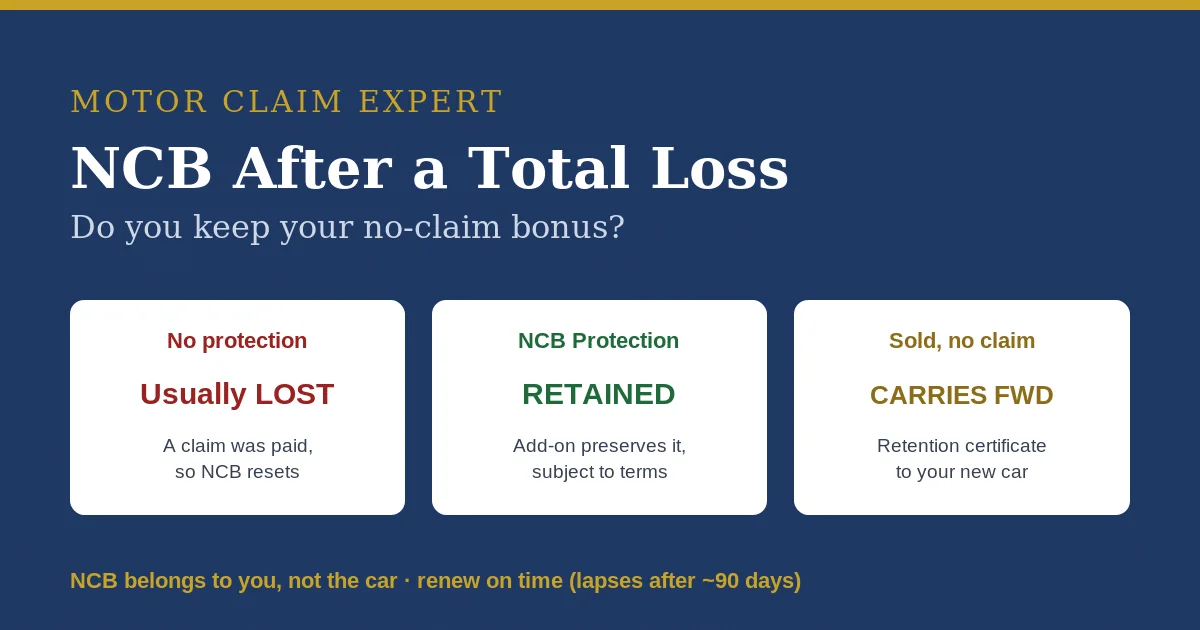
Short answer: in a normal total-loss settlement you lose your accumulated No-Claim Bonus — because a claim has been paid, and the NCB rewards a claim-free record. There are two important exceptions. If you hold the NCB Protection add-on, your bonus survives the claim. And because the NCB belongs to you, not the car, if you had not claimed and simply replaced the vehicle, it carries forward through a retention certificate. Which situation you are in decides whether years of discount survive — and, as the worked example below shows, that can be worth far more than most people expect. This guide covers exactly what happens, how the protection add-on changes it, and how to carry the bonus to a replacement car.
Why a total loss usually wipes your NCB
The No-Claim Bonus is a discount you earn for each consecutive claim-free year, and it applies only to the own-damage part of your premium — not the third-party portion. A total loss — from a major accident or theft — is settled by the insurer paying you the car’s Insured Declared Value. That payout is a claim, so your claim-free streak ends and, at the next renewal, the NCB generally resets to zero. It is the same principle as any own-damage claim resetting the bonus — a total loss is simply the largest version of it.
What your NCB is actually worth
The bonus climbs a fixed ladder with each claim-free year, and it takes five clean years to reach the top slab:
| Consecutive claim-free years | NCB discount on own-damage premium |
|---|---|
| After 1 year | 20% |
| After 2 years | 25% |
| After 3 years | 35% |
| After 4 years | 45% |
| After 5 or more years | 50% |
The true cost of losing it — a worked example
The single-year saving understates the loss, because rebuilding the bonus takes five more claim-free years. Suppose your own-damage premium works out to about ₹18,000 before NCB. At a 50% bonus you pay ₹9,000. Lose it in an unprotected total loss and you start again at zero — here is the extra you pay while the ladder rebuilds, compared with keeping the 50%:
| Year after the loss | NCB | OD premium you pay | Extra vs keeping 50% |
|---|---|---|---|
| Year 1 | 0% | ₹18,000 | +₹9,000 |
| Year 2 | 20% | ₹14,400 | +₹5,400 |
| Year 3 | 25% | ₹13,500 | +₹4,500 |
| Year 4 | 35% | ₹11,700 | +₹2,700 |
| Year 5 | 45% | ₹9,900 | +₹900 |
| Total extra over 5 years | ≈ ₹22,500 |
The exception: the NCB Protection add-on
The one reliable way to keep your bonus through a total loss is the NCB Protection (or NCB Protector) add-on, bought with a comprehensive policy. It lets you retain your accumulated NCB even after a claim — subject to its own terms, which typically allow a set number of claims in a year before the protection is exhausted and the bonus then steps down. If you hold it, your discount survives the write-off and carries to your next policy; if you do not, the total-loss claim takes the bonus with it. Given the rebuild cost shown above, it is exactly the situation the add-on exists for.
Your NCB belongs to you, not the car
The bonus is tied to you as the insured, not to the vehicle, which is what makes a replacement possible. Two rules matter. First, when you replace the car without having claimed, your insurer issues an NCB retention certificate — commonly valid for up to about three years — that you hand to the insurer of your new car to carry the slab across. Second, watch the renewal window: NCB is preserved only if you renew within 90 days of the policy’s expiry; let the gap run longer and the bonus lapses to zero regardless of your record. After a total loss, renew the replacement policy promptly so a timing slip does not cost you what the claim itself did not.
What happens in each situation
| Situation | What happens to your NCB |
|---|---|
| Total loss claim, no NCB Protection | Lost — resets to 0% at renewal |
| Total loss claim, with NCB Protection | Retained, subject to the add-on’s terms |
| Car sold/replaced, no claim made | Carries forward via a retention certificate |
| Renewal delayed beyond 90 days | Lapses to 0%, whatever your record |
What to do around a total-loss settlement
- Check whether you hold NCB Protection before assuming the bonus is gone — it may already be safe.
- Get your NCB position in writing at settlement, so there is no dispute when you insure the new car.
- Ask for a retention certificate if you are entitled to one, and note its validity window.
- Renew the replacement policy within 90 days to avoid a lapse wiping the bonus.
- Add NCB Protection to the new policy if your slab is high — the rebuild cost above shows why it is usually worth the small premium.
Frequently Asked Questions — NCB After a Total Loss
Do I lose my No-Claim Bonus if my car is a total loss?
Usually yes, unless you have the NCB Protection add-on. A total-loss settlement is a claim, so your claim-free record ends and the NCB generally resets to zero at renewal. With NCB Protection, you keep the bonus subject to the add-on’s terms.
Does the NCB Protection add-on cover a total loss?
Generally yes — that is a key reason to buy it. It lets you retain accumulated NCB after a claim, including a total loss, though most versions limit how many claims are protected. Check your add-on wording for the exact terms.
Can I transfer my NCB to a new car after a write-off?
If the bonus survived — because you held NCB Protection, or because you sold the car rather than claiming — yes. You use an NCB retention certificate from your previous insurer and apply the discount to the new car’s policy.
Is the NCB attached to the car or to me?
To you, the policyholder. It reflects your claim-free record, not the specific vehicle, which is why it can move to a new car — provided no claim reset it and the policy was renewed in time.
How long is an NCB certificate valid?
Generally about three years from when the old policy expired or was cancelled, giving you time between cars. But the bonus only stays valid if you renew on time; a delay beyond roughly 90 days typically causes it to lapse. Confirm the exact period with your insurer.
What if I didn’t have NCB Protection?
Then a total-loss claim generally takes your accumulated NCB with it, and you start rebuilding from zero on your next claim-free year. The lesson for the future is to add NCB Protection once your slab is high enough to be worth safeguarding.
Does theft count the same as an accident total loss for NCB?
Yes. A theft that is settled at IDV is treated as a claim in the same way as an accident write-off, so the NCB is generally lost unless you have NCB Protection.
Sources & official references
- Standard NCB ladder: the slabs of 20%, 25%, 35%, 45% and 50% for one to five-plus consecutive claim-free years derive from the India Motor Tariff and carry into today’s IRDAI-approved motor policy wordings; the discount applies to the own-damage premium only.
- Renewal grace / lapse: the NCB is preserved only if the policy is renewed within 90 days of its expiry, as reflected in standard policy wordings.
- Product note: NCB Protection is an optional IRDAI-filed add-on; the number of claims allowed before the protection is exhausted, and the retention-certificate validity, are set by each insurer and vary.


