
It is a common story. A CNG or LPG kit gets fitted at a local workshop to cut running costs, nobody tells the insurer or the RTO, and months later a claim is filed. The surveyor opens the boot, sees the cylinder, and the claim is repudiated for a “material non-disclosure.” At that point most owners assume the money is simply gone.
Two things are true at once, and holding both is the key to this topic. Yes, fitting a bi-fuel kit and not declaring it is a genuine breach of your policy. But no, that breach does not automatically kill every claim — and whether the rejection stands often turns on a single question the insurer would rather you did not ask.
Why the insurer rejects an undeclared kit
A motor policy is a contract of good faith built on accurate disclosure. A CNG/LPG conversion is treated as a material change in the risk: it adds a pressurised-gas fire and explosion hazard, and it adds value to the vehicle that was never underwritten. When the kit was never declared, the insurer leans on two arguments:
- The kit is not insured. Without the correct endorsement, the kit itself carries no cover — so any damage to the kit is simply outside the policy.
- Non-disclosure of a material fact. The insurer argues that had it known, it would have charged more or assessed the risk differently, and that the omission entitles it to repudiate.
This is why a surveyor who spots an undeclared kit will almost always flag it, and why the first letter you receive is usually a repudiation.
What you were actually required to do
The compliance path for a bi-fuel conversion has three legs, and skipping any one of them creates the problem:
| Step | What it involves | Why it matters |
|---|---|---|
| 1. RTO endorsement | Get the car’s registration certificate (RC) changed to reflect dual-fuel status, using an AIS-024 approved kit and installation certificate. | An unendorsed conversion is not road-legal; the RC must match the vehicle. |
| 2. Inform the insurer | Send the installation certificate, updated RC and the kit invoice, and ask for the policy to be endorsed. | This is the “declaration” whose absence the insurer relies on to reject. |
| 3. Add the kit endorsement | Add IMT-25 for own-damage cover on the kit (at additional premium), plus the separate third-party endorsement for the kit’s liability. | This is what actually insures the kit and closes the disclosure gap. |
What IMT-25 actually covers
IMT-25 is the India Motor Tariff endorsement titled “CNG/LPG Kit in Bi-Fuel System (Own Damage cover for the kit).” In plain terms, it indemnifies you for accidental loss or damage to the kit or bi-fuel system as approved by the RTA, up to the kit’s separately declared value, at an additional own-damage premium (commonly around 4–5% of the kit’s value, or 5% extra on the own-damage premium where the kit’s value is not separately stated). Third-party liability arising from the kit needs its own endorsement at a small extra premium.
The practical takeaway: without IMT-25, the kit is uninsured — full stop. Damage to the cylinder or regulator is never payable. That is a narrow, defensible exclusion. It is very different from the insurer using the missing endorsement to reject a claim that has nothing to do with the kit at all.
The question that decides your claim: is the loss connected to the kit?
This is the heart of the matter, and where many rejections quietly fall apart. Indian consumer forums and the Supreme Court draw a firm line between a fundamental breach connected to the loss and a technical breach that had nothing to do with it.
| Scenario | Is rejection usually justified? |
|---|---|
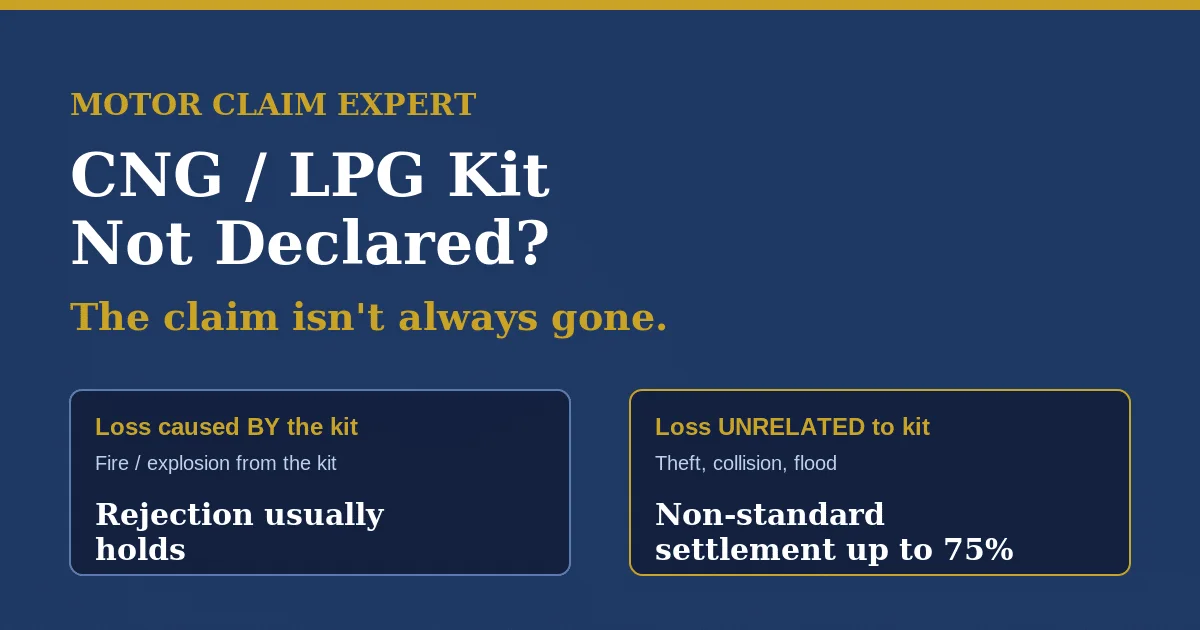
| Fire or explosion originating from the undeclared kit | Yes. The undisclosed hazard directly caused the loss — a strong ground to repudiate. |
| Car stolen; kit had no role in the theft | Usually not. The breach is unconnected to the loss. |
| Rear-end collision or third-party accident unrelated to the fuel system | Usually not. The kit did not cause the damage. |
| Flood or hail damage to the body | Usually not. No nexus between the kit and the loss. |
The governing precedent is Amalendu Sahoo v. Oriental Insurance Co. Ltd., (2010) 4 SCC 536, where the Supreme Court held that where a policy breach is not fundamental, the insurer cannot repudiate the whole claim and must settle it on a “non-standard basis” — up to 75% of the otherwise admissible amount. Consumer forums have applied exactly this reasoning to undeclared-CNG cases: where a fire was not attributed to the kit, and where a theft or accident had no link to it, rejecting the entire claim was held to be a deficiency in service.
If your claim has already been rejected on this ground
Do not accept a one-line repudiation as the end of the road. The insurer must give you the rejection in writing with reasons. Then:
- Pin down the cause of loss. If the surveyor’s own report does not attribute the damage to the kit, that report is your best evidence of “no nexus.”
- Reply in writing, citing the non-standard-settlement principle and asking the insurer to reconsider rather than repudiate in full.
- Escalate through the grievance officer, then the Insurance Ombudsman, if the insurer holds firm.
Myth versus reality
| What you are told | What actually applies |
|---|---|
| “An undeclared kit voids the entire policy.” | Only a breach connected to the loss is fundamental; an unconnected breach usually gets non-standard settlement. |
| “You get nothing if the kit isn’t declared.” | The kit itself is uninsured without IMT-25 — but the rest of the vehicle’s claim may still be payable up to 75%. |
| “Declaring later is pointless.” | Endorsing the kit now (RTO + insurer + IMT-25) protects every future claim and is inexpensive. |
| “The surveyor won’t notice a small kit.” | Surveyors routinely find kits; concealment only adds a suppression ground against you. |
The bottom line
An undeclared CNG or LPG kit is a real breach, and the honest first move is to fix it: get the RC endorsed, tell your insurer, and add IMT-25 so the kit is actually covered. But if a claim has already been rejected purely because the kit was undeclared, the decisive question is whether the loss had anything to do with the kit. If it did not, a total rejection is very often unsustainable, and the law points to a non-standard settlement rather than nothing at all.
Frequently asked questions
Can my car insurance claim be rejected if I didn’t declare my CNG/LPG kit?
Yes, it can be — non-declaration of a bi-fuel kit is a genuine breach of the disclosure your policy is based on, and insurers routinely repudiate on this ground. But rejection is not automatic for every claim: whether it stands usually depends on whether the loss was connected to the kit.
Does an undeclared CNG kit void the entire policy?
Not necessarily. Indian courts distinguish a fundamental breach connected to the loss from a technical breach that had nothing to do with it. In Amalendu Sahoo v. Oriental Insurance, (2010) 4 SCC 536, the Supreme Court held that where the breach is not fundamental, the claim must be settled on a non-standard basis — up to 75% of the admissible amount — rather than rejected in full.
What is IMT-25 in car insurance?
IMT-25 is the India Motor Tariff endorsement titled ‘CNG/LPG Kit in Bi-Fuel System (Own Damage cover for the kit)’. It insures accidental loss or damage to the RTA-approved kit up to its separately declared value, at an additional own-damage premium. Without IMT-25, the kit itself is uninsured.
My car was stolen but I hadn’t declared the CNG kit — will I get anything?
Very possibly. A theft has no connection to whether a CNG kit was declared, so this is a technical breach, not a fundamental one. On the Amalendu Sahoo principle you have a strong case for settlement on a non-standard basis (typically up to 75% of the IDV) rather than a total rejection.
How do I declare a CNG/LPG kit to my insurer?
Send your insurer the kit installation certificate, the updated RC showing dual-fuel status, and the kit invoice, and ask them to add IMT-25 (own-damage cover for the kit) plus the third-party endorsement, against a small additional premium. Do this immediately after fitting the kit.
Is a CNG kit legal without RTO endorsement?
No. A bi-fuel conversion must use an AIS-024 approved kit and be endorsed on the vehicle’s RC as dual-fuel by the RTO. An unendorsed conversion is not road-legal and can attract fines and RC-cancellation risk, quite apart from the insurance problem.
What is a non-standard settlement (75%)?
It is a settlement where the insurer, instead of rejecting a claim outright for a policy breach, pays a reduced share — commonly up to 75% of the otherwise admissible amount. Indian consumer forums and the Supreme Court apply it where the breach is not fundamental and not connected to the loss.
My claim was rejected only because of an undeclared kit — what should I do?
Get the rejection in writing with reasons, then check the surveyor’s report for the cause of loss. If the damage was not attributed to the kit, reply in writing citing the non-standard-settlement principle, and escalate to the grievance officer and then the Insurance Ombudsman if the insurer holds firm.
Sources & official references
- Principle: insurance is a contract of utmost good faith — a CNG/LPG kit not declared to the insurer can be treated as the non-disclosure of a material fact.
- Regulation: a CNG/LPG kit must be endorsed on the vehicle’s registration certificate under the Central Motor Vehicles Rules, 1989, and reflected in the policy.
- Relief: where the undeclared kit did not cause or aggravate the loss, a non-standard (part) settlement may apply rather than a full repudiation; escalate via the IRDAI Bima Bharosa (IGMS) portal or the Insurance Ombudsman.


