
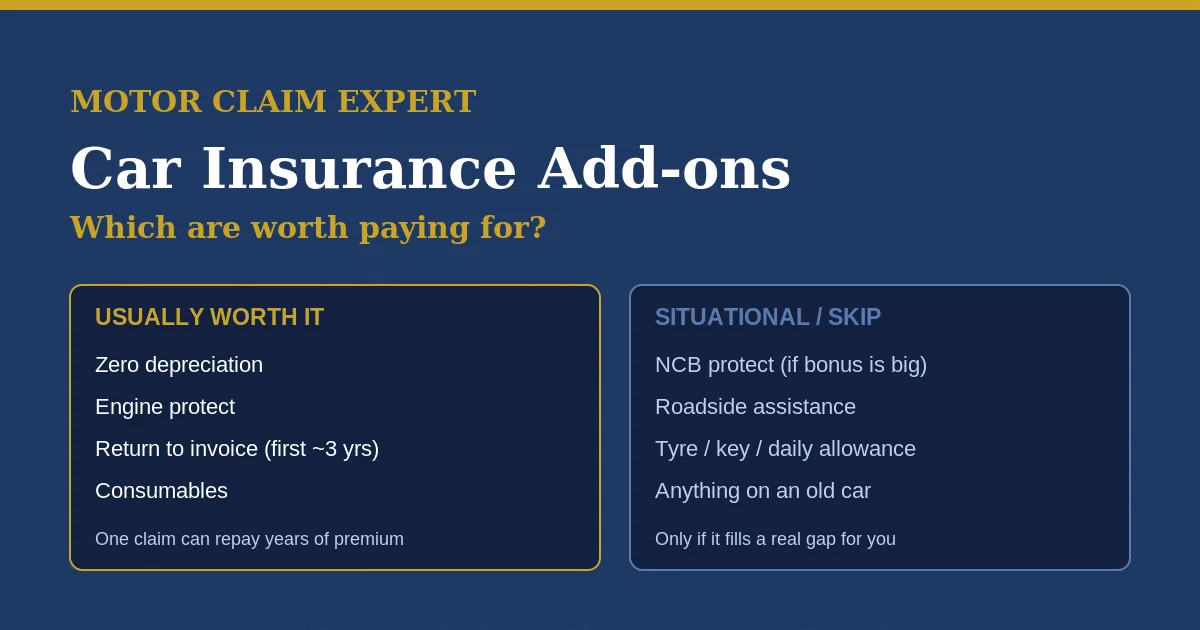
A comprehensive policy sounds complete, but it has real holes: it depreciates every replaced part, it excludes several kinds of engine damage, and on a write-off it pays the depreciated IDV rather than what you paid for the car. Add-ons exist to patch those specific gaps. The catch is that insurers will happily sell you every add-on on the list, and you do not need all of them.
The test for any add-on is simple: does it cover a gap you are genuinely exposed to, and would one likely claim beat several years of the premium? Judged that way, a handful are close to essential and the rest are situational. Here is how they actually stack up.
The add-ons that usually earn their place
For a car under about five years old, four add-ons repay themselves on a single realistic claim:
| Add-on | Gap it fills | Typical cost / year | Verdict |
|---|---|---|---|
| Zero depreciation | The base policy depreciates every replaced part | Part of a ₹2,700–8,700 stack | Near-essential under 5 years |
| Engine protect | The base policy excludes water-ingress and oil-leak engine damage | ~₹500–1,500 | Essential if flood-prone |
| Return to invoice | A write-off pays IDV, not what you paid | ~10–15% of premium | Worth it in the first ~3 years |
| Consumables | Oil, coolant, nuts and bolts are not paid | Low; often bundled | Cheap insurance on every claim |
Costs vary by insurer, car and city — treat these as typical figures and check your own quote.
Zero depreciation: the default choice for a newer car
Every ordinary repair claim is reduced by the depreciation grid — 50% off plastics and tyres, an age scale on metal, half the paint material. Zero depreciation (also called nil-dep or bumper-to-bumper) waives that cut, so the insurer pays the full cost of replaced parts. A single plastic bumper claim of ₹7,000 recovers roughly ₹3,500 you would otherwise lose — often one to a few years of the add-on’s cost in a single claim. It is usually offered only for cars up to around five years old and may cap the number of nil-dep claims per year.
Engine protect: the most valuable patch after zero-dep
This is the add-on our readers most often wish they had bought. A standard policy covers accidental damage but excludes consequential engine damage — the hydrostatic-lock seizure that follows restarting a car in a flood, and seizures from oil or coolant leaks. Engine protect covers exactly that gap. At roughly ₹500–1,500 a year it can pay ₹60,000 to ₹1.5 lakh on a single seizure, so one claim covers many years of premium. If you live in a coastal or flood-prone city, this is close to compulsory.
Return to invoice: powerful, but only early
On a total loss or theft, a normal policy pays the IDV — the depreciated value — which can be well below what you paid. Return to invoice (RTI) instead pays the full invoice or on-road price: ex-showroom plus registration and road tax. In the first three years the gap between invoice and IDV is at its widest, often ₹1–3 lakh, which is exactly when RTI earns its ~10–15% premium premium. It applies only to a total loss or theft, and is usually available only for cars up to three to five years old. After that the gap shrinks and RTI stops being worth it.
The situational add-ons
- NCB protection preserves your no-claim bonus even after a claim (typically one), so a single claim does not wipe out a discount you have spent years building. Worth it once your bonus is large.
- Roadside assistance — towing, jump-start, flat-tyre help, emergency fuel and lockout support — is inexpensive and pure convenience; useful if you drive long distances or in unfamiliar areas.
- Consumables cover picks up the small items deducted on every repair bill (in cashless or reimbursement alike); it is usually cheap and pairs naturally with zero-dep.
The ones to think twice about
Tyre protection, key replacement and daily-allowance covers are genuinely useful only if you specifically expect to need them — otherwise they add premium for a low-probability payout. And do not chase add-ons on an older car: zero-dep and RTI are usually unavailable past five and three-to-five years respectively, so on an older vehicle the sensible focus is engine protect (if you are flood-prone) plus a sound base cover, not a long add-on list.
Which add-ons by car age
| Car age | What to buy |
|---|---|
| 0–3 years | The full stack — zero-dep, engine protect, consumables, NCB protect — plus RTI while the invoice-to-IDV gap is wide. |
| 3–5 years | Zero-dep and engine protect (add consumables); RTI is marginal. |
| Over 5 years | Most add-ons are unavailable — prioritise engine protect if you are flood-prone, and make sure the base cover and IDV are right. |
Myth versus reality
| What you are told | What is true |
|---|---|
| “Comprehensive covers everything.” | It depreciates parts, excludes some engine damage, and pays IDV not invoice — add-ons patch those holes. |
| “Buy every add-on to be safe.” | Only buy the ones that cover a gap you are actually exposed to; the rest just add premium. |
| “RTI is always worth it.” | Only in the first ~3 years and only on total loss or theft; the value fades as IDV and invoice converge. |
| “Add-ons work on any car.” | Zero-dep and RTI are age-limited; on older cars most are unavailable. |
The bottom line
Add-ons are not upsells to resist on principle — they are targeted fixes for the specific holes a comprehensive policy leaves. For a newer car, zero depreciation and engine protect are close to essential, return to invoice is valuable for the first few years, and consumables is cheap insurance on every claim. Beyond those, buy only what matches your car, your city and your driving. Match the add-on to a real gap and the premium pays for itself; buy on autopilot and it just inflates the bill.
Frequently asked questions
In the monsoon, the most valuable add-on for many owners is Engine Protection — it covers the water-ingress engine damage comprehensive cover excludes.
Zero depreciation is a strong add-on, but it doesn’t remove every deduction — see what a zero-dep claim still deducts. For a map of every line that reduces a repair cheque, see every deduction, explained.
For the single most-bought add-on, we have a dedicated decision guide: zero dep vs comprehensive — is it worth it for your car’s age.
Add-ons sit on top of an own-damage or comprehensive policy. Not sure which base you need? See third-party vs own damage vs comprehensive car insurance.
Which car insurance add-ons are actually worth it?
For a car under about five years old, four add-ons usually repay themselves on a single realistic claim: zero depreciation, engine protect, return to invoice (in the first few years), and consumables. Beyond those, NCB protection, roadside assistance and others are situational — buy them only if they cover a gap you are genuinely exposed to.
Is zero depreciation cover worth it?
For a newer car, yes. Every ordinary repair claim is reduced by the depreciation grid (50% on plastics and tyres, an age scale on metal). Zero-dep waives that, so the insurer pays the full cost of replaced parts. A single plastic bumper claim often recovers one to a few years of the add-on’s cost. It is usually available only for cars up to around five years old.
What does engine protection cover that a normal policy doesn’t?
A standard policy covers accidental damage but excludes consequential engine damage — hydrostatic-lock seizure from restarting a flooded car, and seizures from oil or coolant leaks. Engine protect covers exactly that gap. At roughly ₹500–1,500 a year it can pay ₹60,000 to ₹1.5 lakh on one seizure, so a single claim covers many years of premium. It is close to essential in flood-prone cities.
Is return to invoice (RTI) worth it?
Only early. On a total loss or theft, a normal policy pays the depreciated IDV; RTI pays the full invoice or on-road price instead. The gap is widest in the first three years — often ₹1–3 lakh — which is when RTI’s ~10–15% premium is justified. It applies only to total loss or theft and is usually available only for cars up to three to five years old.
What is the difference between zero depreciation and return to invoice?
Zero depreciation covers repair claims — it removes the depreciation cut on replaced parts. Return to invoice covers only total loss or theft — it pays your invoice price instead of the depreciated IDV. They protect different scenarios (partial damage vs write-off/theft), so for a new car it often makes sense to hold both.
Do car insurance add-ons work on old cars?
Many do not. Zero depreciation is usually limited to cars up to around five years, and return to invoice to three to five years. On an older car most add-ons are unavailable, so the sensible focus is engine protect (if you are flood-prone) plus a sound base cover and a correct IDV.
How much do car insurance add-ons cost?
For a newer sedan, the core stack — zero-dep, engine protect, NCB protect and consumables — typically runs about ₹2,700–8,700 a year, raising the total premium by roughly 15–40%. Engine protect alone is around ₹500–1,500. Costs vary by insurer, car and city, so check your quote; one claim above about ₹25,000 usually recovers the whole stack.
Is NCB protection worth buying?
It is worth it once your no-claim bonus is large. NCB protection lets you make a claim (typically one) without losing the accumulated discount, preserving a saving you may have built over several claim-free years. If your bonus is still small, the add-on matters less.


